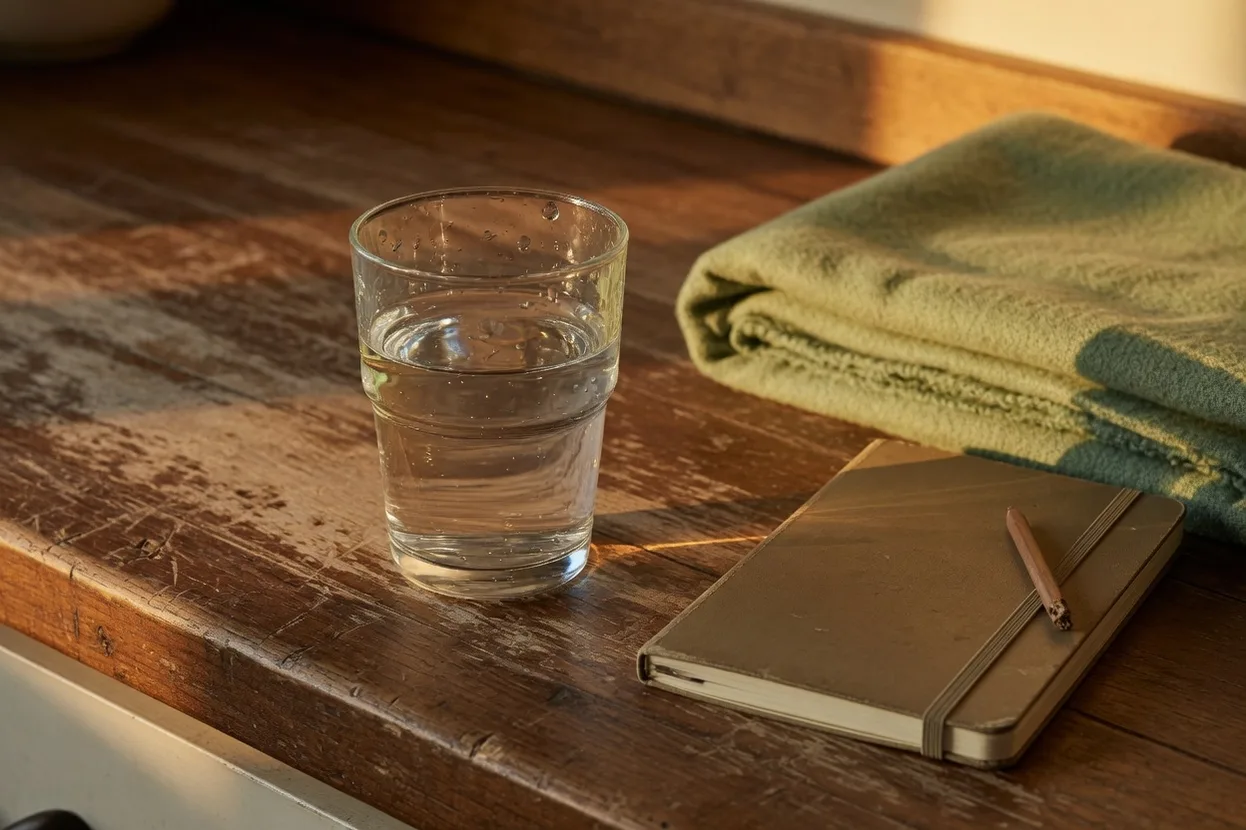
Shaking after breathwork shows up in this glass of water on the counter, not in a story about letting go. The blanket is already folded, sage green, a neat rectangle. The mat is gone. The surface still carries fine rings that will not lie flat, while you are already standing with your hands at your sides.
Your thighs join in. Or your pelvis. Sometimes your arms. Nobody said: shake now. It starts on its own, after a long yin hold or after a round of breath. It feels odd. A bit silly. As if the body made a joke at the exact moment you thought you were done.
This is not proof the practice worked. It is not a treatment for illness either. It is a cue to notice how long it lasts, and to know when you stop.
When you stop, not when the shaking has finished itself
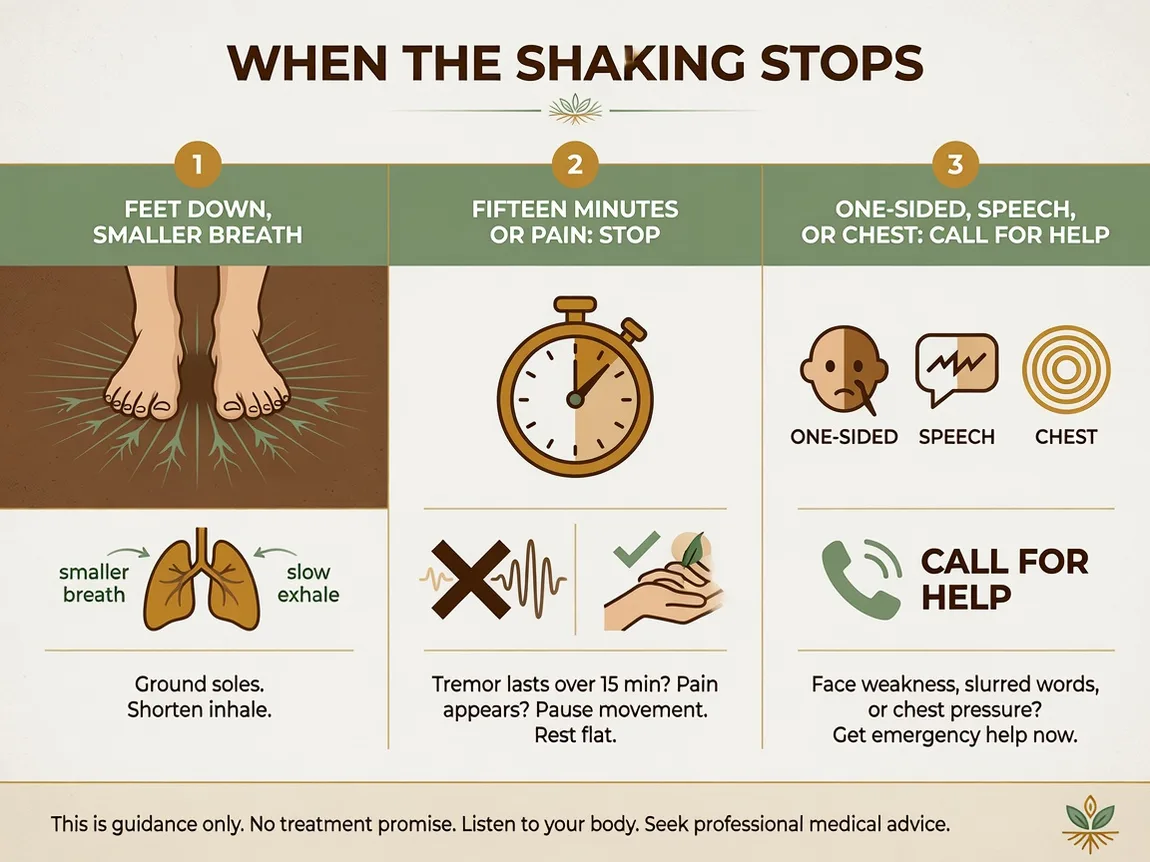
A stop line is the moment you make the pose and the breath smaller, or quit altogether: after about fifteen minutes, with pain, dizziness, or fear, and at once with one-sided shaking, trouble speaking, or chest pain.
- Stop line
- A stop line is the moment you shrink the pose and the breath, or stop completely: after about fifteen minutes, with pain, dizziness, or fear, and immediately with one-sided shaking, speech trouble, or chest pain.
Fifteen minutes is a practical line in this text. Not a medical standard. Stopping earlier is always allowed. You do not have to sit the shaking out until it feels "finished".
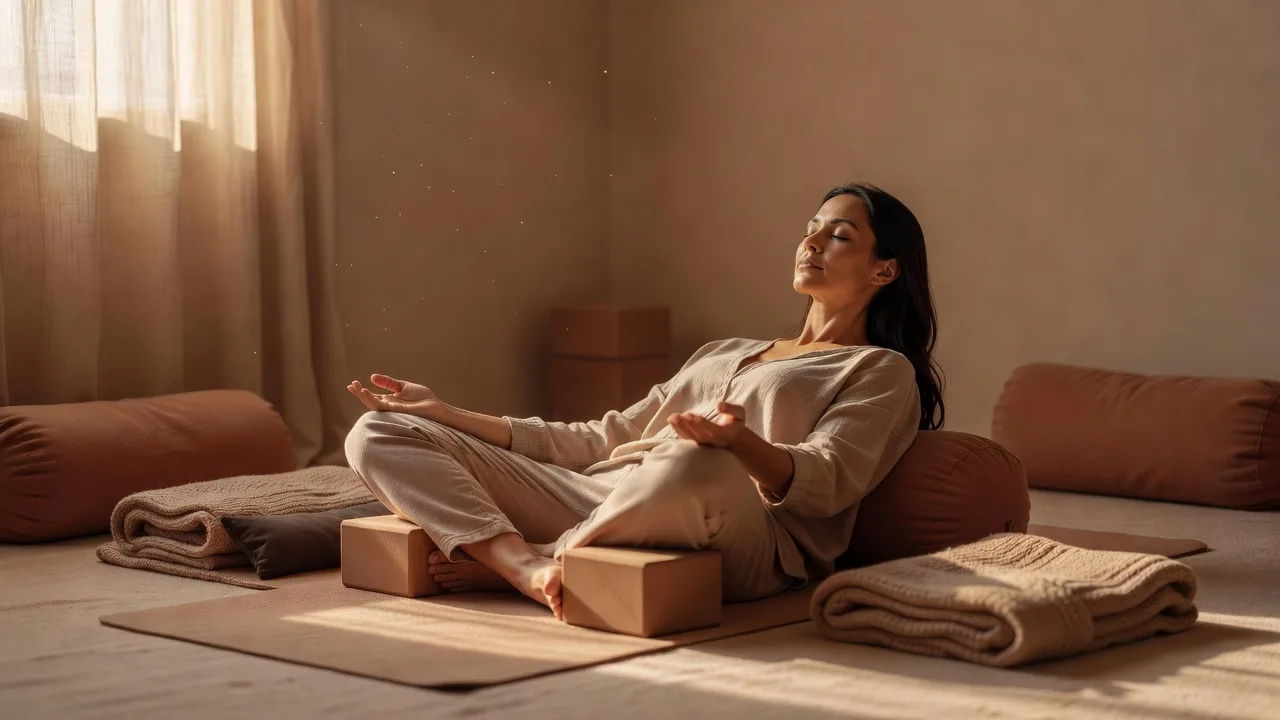
Set your feet flat. Soft knees. Hands on your thighs. Make the breath smaller and quieter, not deeper. The glass on the counter can finish its ripples. You do not have to blow into it. The free breathing timer helps you time that smaller breath without chasing it.
With a hernia, acute pain, or recent surgery, this article is the wrong room. See a doctor first. The same if the shake stays on one side, if words stop arriving, or if the chest hurts. Then you call for help. No pose on top of that.
| What you notice | What you do | What you skip |
|---|---|---|
| A fine shake in both legs or the pelvis, seconds to a few minutes, no pain | Feet down, smaller breath, watch whether it settles | Breathing deeper to make it bigger |
| It continues, gets stronger, or dizziness or fear joins it | Stop the pose and the session, even before fifteen minutes | Sitting it out until it feels "done" |
| One side, speech that stumbles, chest pain, or a tremor that has followed you for weeks at rest | Help or a doctor, not this text | Explaining it as a successful yin class |
What a neurogenic tremor is, and what it is not
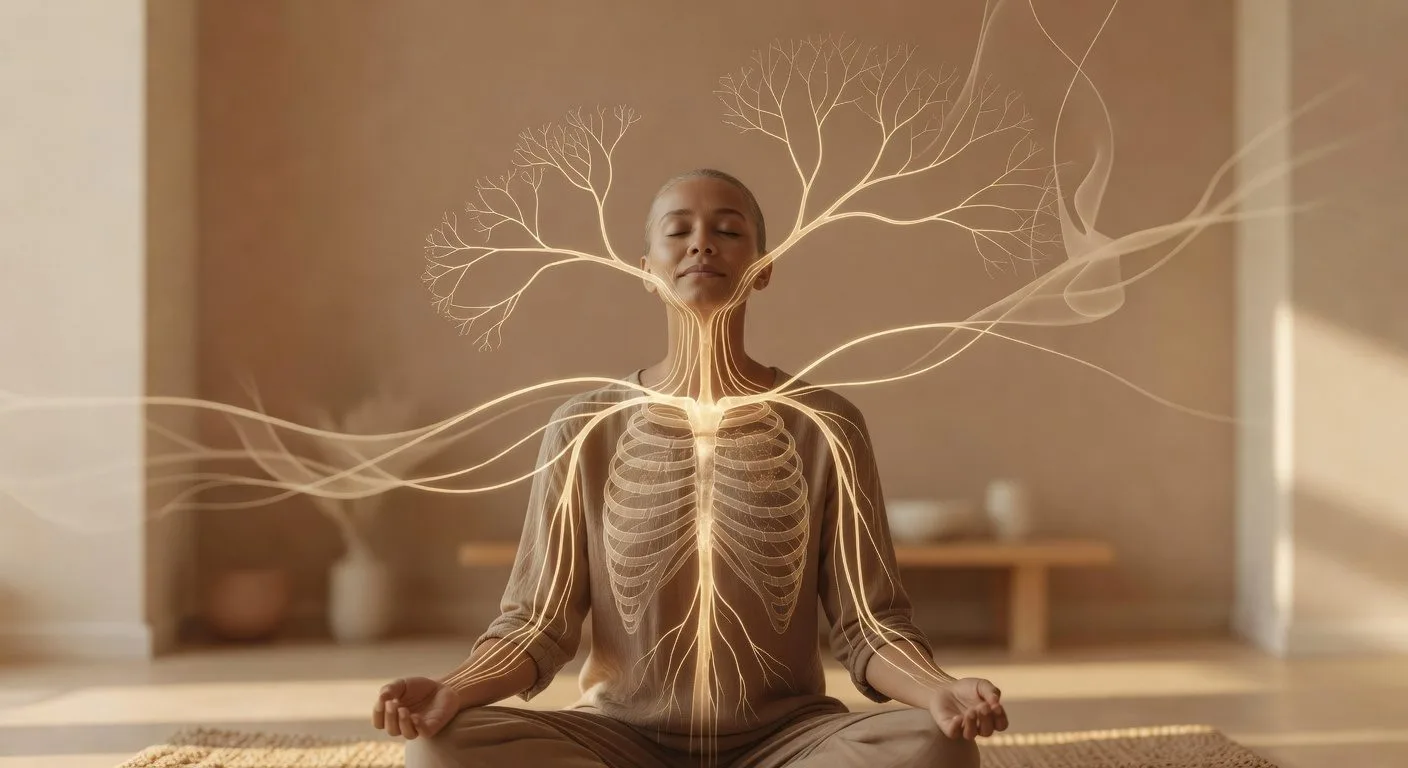
A neurogenic tremor is an involuntary shake the body starts on its own, often in the legs or pelvis, without you steering it. After yin or breathwork it can show up when a muscle held tension and the nervous system drops at the same time.
- Neurogenic tremor
- Neurogenic tremor is an involuntary shake the body starts itself, often in the legs or pelvis, without you steering it. After yin or breathwork it can arise as tension drops. It is not a diagnosis and not a sign that a practice succeeded.
You can feel the difference from a muscle you tighten on purpose. A deliberate squeeze, you can release. Here, not right away. The shake keeps going while you think: I am not doing anything. That is the point. You are not directing it, so you do not have to direct it either.
In the literature the name is neurogenic tremor. On the mat it feels less tidy. Cold sweat in the backs of the knees. A jaw that loosens. Sometimes a laugh that fits nothing, because startle and relief land in the same second.
A small, passing shake after a long hold is different from a tremor that has followed you for weeks at rest, while writing, or while walking. That second kind belongs with a doctor. This text does not explain a disease and does not promise a cure. New, short, and tied to the session, you may watch it while you stop. Old, one-sided, or paired with other nerve symptoms, you get it checked.
Pro-tip: Afterward write one sentence: where it sat, how long it lasted, whether it settled when you stopped. No story about release.
Why it shows up right when you thought you were calm
Yin asks you to stay. A hip, a groin, the front of a thigh. The muscle keeps tension even when you think you have "sunk in". Breathwork does something else and sometimes the same thing: the breath gets bigger, the body warmer, and then the tone drops.
That drop is the moment some people start to shake. Not because the class succeeded. Because tension and the nervous system step down together, and the body unwinds that with a jolt. Same as the glass. The hand is already gone. The rings are still running.
You do not have to pin a meaning on it. No "I am releasing trauma". No score. If you want to see how hip and psoas hold tension without turning that into a diagnosis, that lives in psoas, hips, and what the body keeps. The steps of a protocol do not belong in a blog there, and they do not belong here.
If a pose was the trigger and you want to check whether yin fits you without jumping into a long class, the short yin check is an honest door. No grade for how well you shook.
What research does and does not say about shaking
People look for a study that says shaking is good, or shaking is dangerous. That study is not here. What is here is narrower. That is better.
A small trial in people with multiple sclerosis followed tension and trauma releasing exercises against usual care for eight weeks, with 28 participants. The primary outcome, fatigue, was not significant in the uncorrected analysis. After correction for unbalanced covariates there was a difference on the fatigue score, plus less reported spasticity and pain. That does not prove shaking resolves trauma, and it says nothing about shaking after yin or breathwork in healthy readers. A small group with a disease is not a mat in a yoga room.
Slow breath does touch the autonomic system, but that is a different sentence. A secondary analysis of 99 healthy adults saw a slight drop in systolic and diastolic pressure after twelve weeks of yoga-based slow breathing. Tremor was not an outcome. A blood pressure drop is not the same as shaking after a pose. Useful as context. Not as an explanation for the glass on your counter.
High ventilation is a third story. In experienced practitioners, the intensity of an altered state tracked with sympathetic activation and blood flow in the insula, amygdala, and hippocampus, during high ventilation plus music. That is not yin. That is not a neurogenic tremor. Do not use it as proof that shaking is a bliss state. Feeling intense and being safe are two measurements.
A study protocol on neurogenic tremor in adolescents with emotional disorders shows this is still sitting inside a trial as an add-on to treatment. A protocol has no results. Different group. Do not carry it over to your yin session this afternoon.
Four sources, four limits. None of the four says: keep shaking until it stops. None of the four says: this heals something.
How to make the breath smaller without feeding the shake
After the pose or the round, stay seated or lying for a moment. Feet flat if you are sitting. Do not chase a bigger tremor. Bigger is not deeper work. Bigger is often just more pushing.
Breathe through the nose if that is available. Shorter than you just did. Quieter. As if you do not want the water to slosh. Three or four breaths are enough to feel whether the wave drops. If it does not, you end the session. You stand up, you drink the glass, you stop folding the practice into a conclusion.
If you want to practice that smaller breath later without a full round, that belongs with breathwork as the wide door, and with breathwork coaching if the shaking returns every session and you want another person in the room. No medical treatment promise. A conversation is not a diagnosis.
How connected breathing meets the nervous system without every round having to end in a shake is in connected breathing and the nervous system. If you want to see what yin and breath can and cannot support, without promoting this shake into proof, that sits beside yin, breath, and what the science actually covers.
A pose that triggered it can be shorter next time. Two minutes instead of five. Or a different line through the body. Yin yoga is not a contest in how long you stay until the body protests.
Pro-tip: If you notice you are making the breath bigger to "finish" the shaking, that is the cue to stop. Finished is not the goal.
The psoas protocol mentions this; the steps do not live here
Yes, shaking belongs with the psoas protocol as a short pointer. The protocol mentions it because the body sometimes trembles as tension drops. The separate steps live in the ebook, not in this text. Spooning the ebook empty would replace the stop line with a recipe, and that is exactly what does not belong here.
The price is 14.95 euro until 18 November 2026 and 29.95 euro after that. Never free. The address is spiriators.com/ebook/psoas-reset, not a free path. The ebook is not a medical treatment. With a hernia, acute pain, or recent surgery, you do not read it as a substitute for a doctor.
If the shaking keeps coming back, even when you stop, shrink the breath, and shorten the pose, a person is more useful than another paragraph. That conversation can be about breath or about yin. It does not promise a cure. It promises you do not have to guess alone whether another fifteen minutes "belongs".
Key takeaways
- Shaking after yin or breath is often a neurogenic tremor: involuntary, not proof you did it right, not a treatment.
- Set your feet down and make the breath smaller. Do not chase a bigger shake.
- Fifteen minutes is a practical outer line here. Stopping earlier is allowed, and required with pain, dizziness, or fear.
- One-sided shaking, speech trouble, or chest pain: call for help. A tremor that has lasted for weeks: a doctor.
- Studies on TRE, slow breathing, high ventilation, and a protocol in adolescents do not explain this glass of water. They mostly show what they do not prove.
- The psoas protocol mentions shaking. The steps stay in the ebook, 14.95 euro until 18 November 2026, then 29.95 euro.
The water goes flat on its own. You do not have to wait for the last ring to vanish before you are allowed to say: enough.