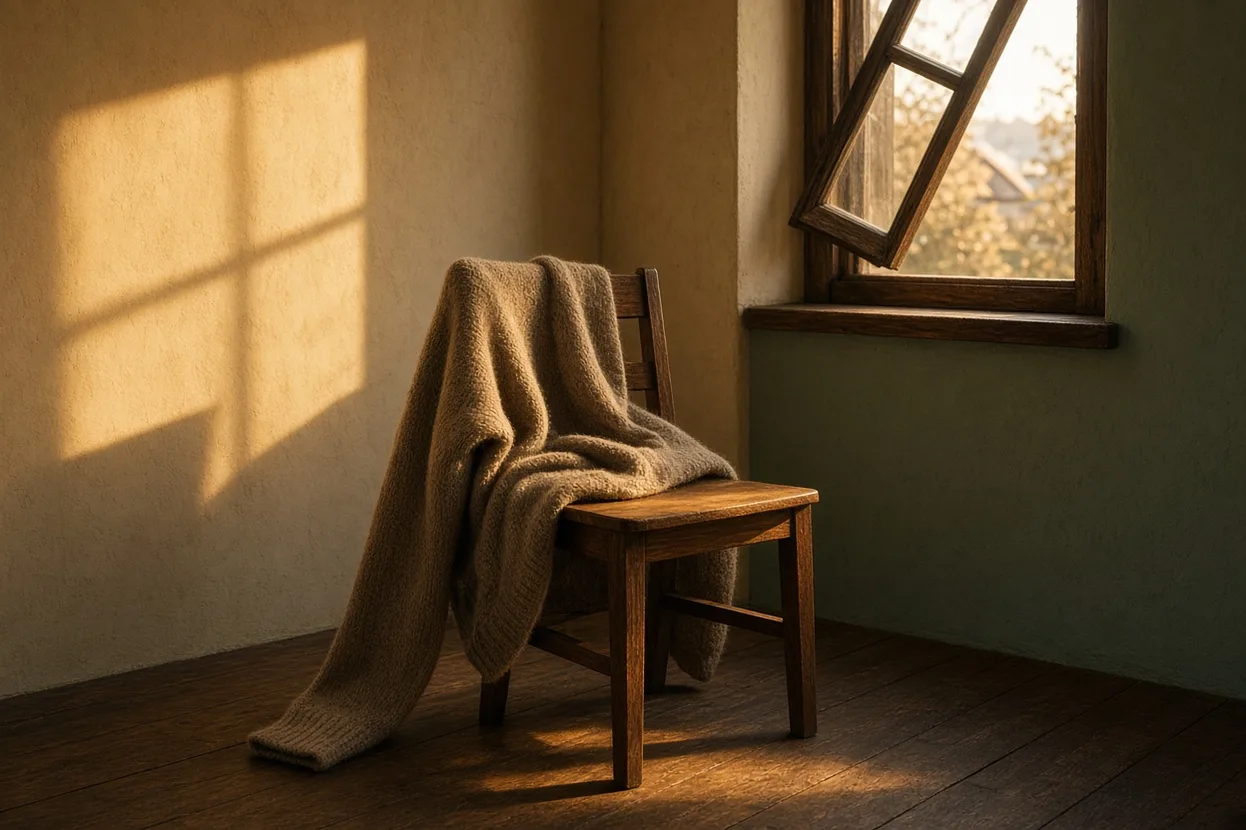
"The cardigan goes on and off in the same minute." She says it while pulling one sleeve off the chair. The other sleeve is still on the floor. The window is cracked open. The room is warm. A cold draft runs along the frame.
Yin yoga menopause starts for her off the mat. It starts with that cardigan. On, because a shiver crosses her shoulders. Off, because a minute later the heat sits in her chest. Two temperatures. One chair. No score, and no promise that the wave will stop.
I hear that sentence more often than a question about poses. Women in the years around the last period are not hunting for a new workout. They want a rhythm that can live with heat, sleep, and a restlessness that does not sit neatly on a clock. Yin yoga is a slow form for that. You stay down. You force nothing.
Yin yoga menopause means staying down
Yin yoga in menopause is a slow practice in which you hold a supported pose for three to five minutes, without earning a deeper stretch and without promising that hot flashes will stop.
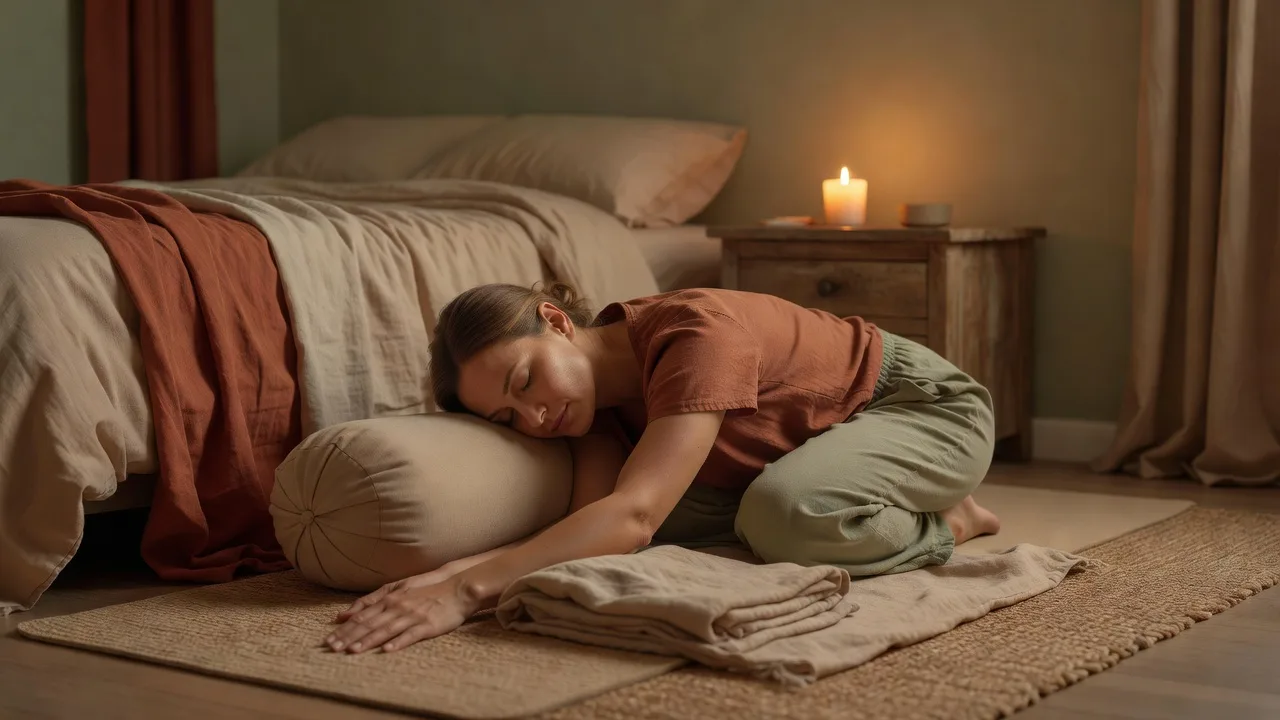
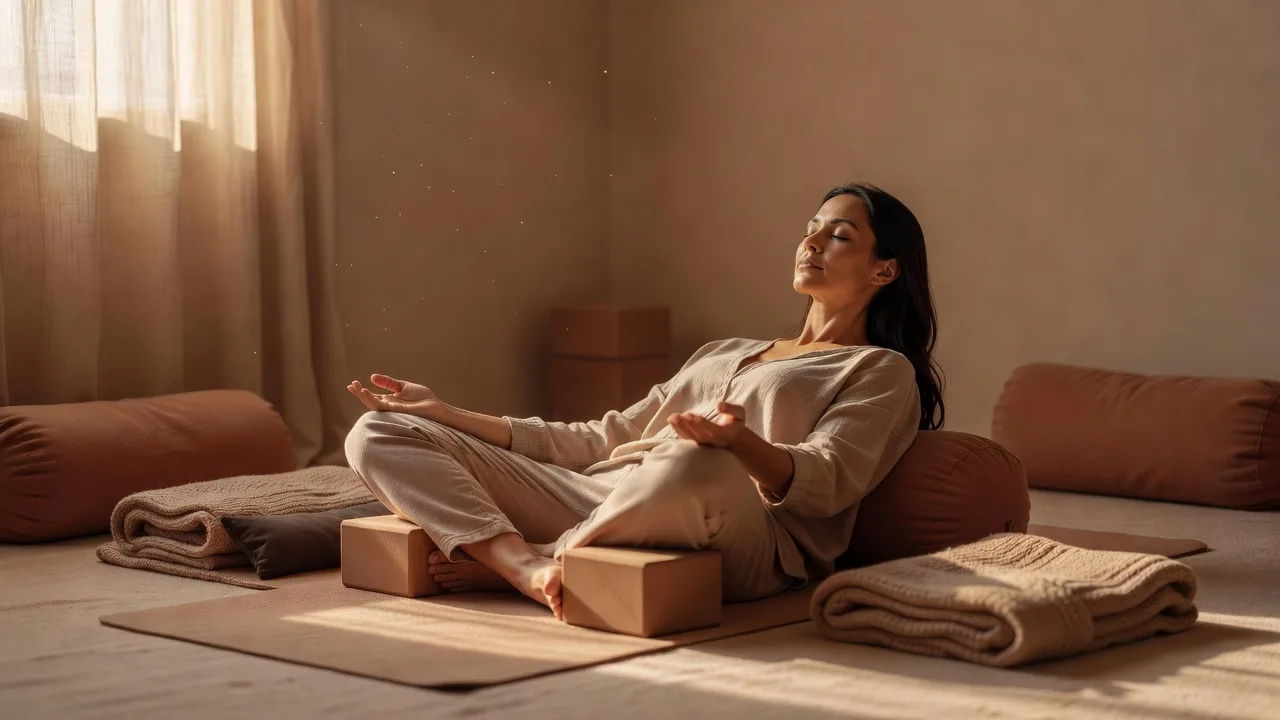
You lie down. The floor carries you. A cushion or a rolled sweater catches the knees, the chest, or the forehead. The breath can keep going on its own. Nobody scores how deep you get. If heat climbs into your head, you come up. If something pulls sharply, you stop. That is the whole agreement.
- Yin yoga
- Yin yoga is a slow form of yoga in which you hold a pose for several minutes with support, without performing for stretch or strength.
In a class with me it looks dull. Someone breathes. Someone pulls a cardigan closer and pushes it away a minute later. That shuffle is not a distraction. It is the subject. Heat and chill in the same minute, with no score attached.
If you want to see whether staying down fits you, try the free yin check. No account. No program. A short mirror before you unroll a mat.
What yoga research shows, and what it does not
Menopause is the span of years around periods stopping, when heat, sleep and mood can shift, and yin yoga is not a treatment for that shift.
- Menopause
- Menopause is the years around periods stopping, when heat, sleep and mood can shift. Yin yoga is not a treatment for it.
I want that line out loud. You can feel better in your body and still get a hot flash. Both can be true on the same night.
A 2025 meta-analysis looked at 24 randomized trials, a little over two thousand women. Yoga lined up with less trouble around sleep, anxiety, mood and physical complaints. For hot flashes there was no clear difference from usual care. The mix of styles is wide. Yin is not its own protocol in there. Dose, how often and how long, stays fuzzy. I use that result as backing for rhythm, not as proof that a pose moves a hormone.
A smaller 2024 trial followed 62 women between 40 and 60. An hour of yoga twice a week for ten weeks. The median score on a symptom scale dropped from 16 to 5, across psychological, physical and urogenital items. Nice to read at the kitchen table. And small. One setting. No follow-up. No yin. Ten weeks inside a study is the study's rhythm, not homework you have to copy.
A 2024 overview of reviews draws the line more honestly. Seventeen reviews, dozens of underlying studies. There are signs that yoga helps physical and urogenital complaints. For hot flashes and psychological complaints the authors call the evidence inconclusive. That overview is not stronger than the meta-analysis above. It stacks older reviews. It still does not isolate yin.
Sleep and mood also show up in a 2025 review on movement. Thirteen trials, yoga next to aerobics, Pilates, strength and stretching. Better sleep and a steadier mood lined up with movement in general. Trial quality varies. Yin was not tested on its own. Calves on a chair tonight do not prove that review. They do give your body a recognizable end to the day.
None of these four studies is a mouse experiment, and none of them proves this one sequence. A trial is not your kitchen. A meta-analysis is not a cushion under your knees. I leave that gap open. A doctor stays the first door for sharp pain, recent surgery, a hernia, or doubt about bleeding.
One sequence, twenty minutes, no menu
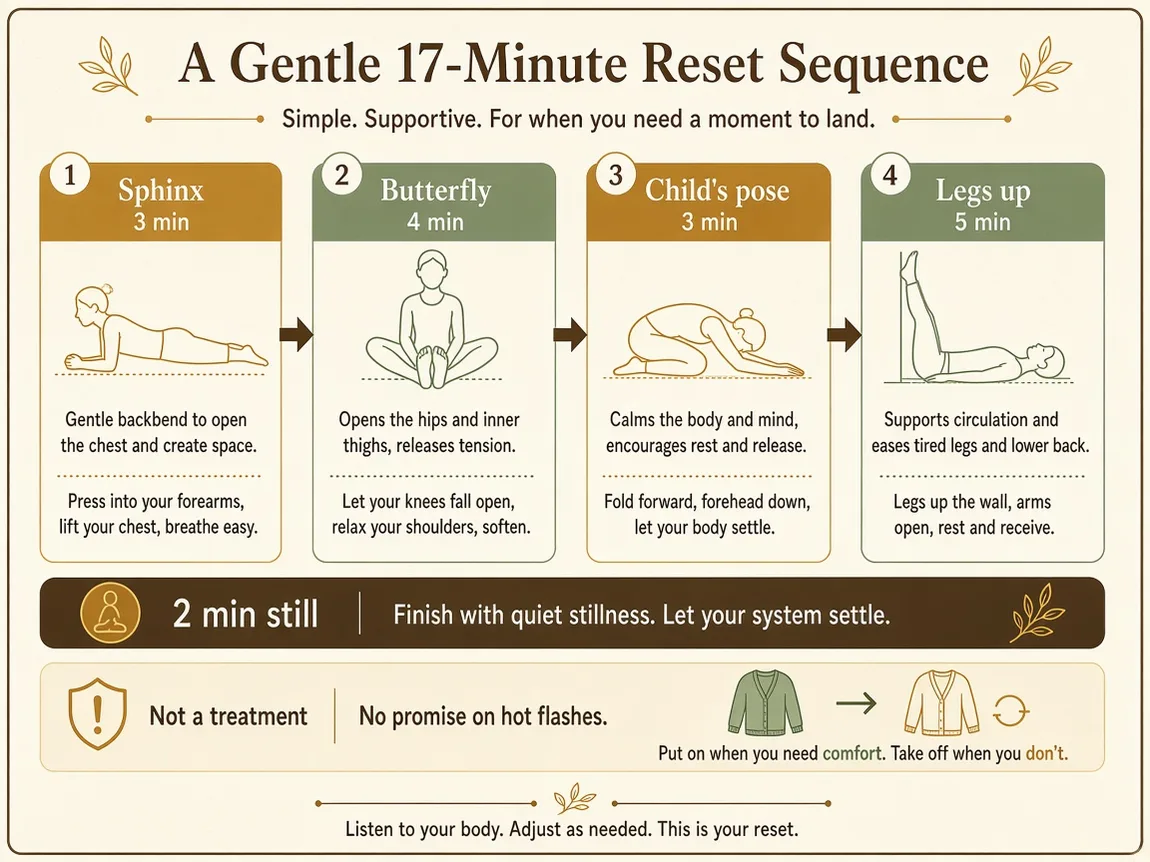
A menopause yin sequence is four supported poses plus two quiet minutes, about twenty minutes in all, with no stretch goal and no fifth trick tacked on.
I do not hand you ten options. Choices make the evening longer. This is one order. You may shorten a pose. You may not deepen it to impress yourself.
| Step | Pose | Time | What to watch |
|---|---|---|---|
| 1 | Sphinx | 3 min | Forearms for support, chest low. Not a cobra. Come up if heat pulls into your head. |
| 2 | Butterfly | 4 min | Soles together, knees supported with whatever is nearby. Pushing means you stop. |
| 3 | Child's pose | 3 min | Forehead supported, knees wide enough to breathe. Shorter if you get dizzy. |
| 4 | Legs up | 5 min | Calves on a chair, hips on the floor. Skip the wall if it makes you dizzy. |
| 5 | Still | 2 min | Hand on the belly. Breath unsteered. The cardigan may be on or off. |
Sphinx is lying on your belly for three minutes, elbows under you. The chest stays low. This is not an opening you have to earn. If warmth climbs into your face, come higher on your forearms or sit up. Done is done.
Butterfly next. On your back or seated, soles together, four minutes. A blanket under each knee if the groins complain. Do not push. Pushing is the old pattern: a little more, then I will count.
Child's pose, three minutes. Forehead on a cushion or on your fists. Knees wide enough for the belly. If you get dizzy, thirty seconds is enough. The clock is not the boss.
Legs up is the longest step. Five minutes. Calves on the seat of a chair. Hips stay on the floor. A wall looks tidy in a photo and feels rough if blood rushes to your head. Pick the chair.
Then two quiet minutes. Hand on the belly. You do not steer the breath into a shape. The cardigan may go on. It may come off. That is the practice, not a sloppy ending.
Pro-tip: Put a kitchen timer out of sight. Watching the minutes left turns lying down into a performance again.
These pose names show up again in the twelve essential yin poses. Same family. Different order. For menopause you stay with these four, plus quiet.
In the studio we do the same thing, with someone else holding the clock. Yin yoga with Tessa is a rhythm, not a workout and not a treatment for hormonal complaints. One class is enough to feel whether the floor carries you.
When you leave the mat alone
Stopping belongs in the sequence. Sharp pain is not a sign to soften into it. It is a sign to come out.
Recent surgery, a hernia, or a doctor's advice about your back comes before these twenty minutes. If you are unsure about bleeding, call a doctor, not a yoga teacher. Research on yoga in menopause reports few serious side effects, but the groups are small and yin is never cut loose from other styles. Few reports is not a free pass.
On the mat, three signals are enough. A sharp pull in the groin, the low back, or the neck. Dizziness that does not settle when you lift your head. A heart rate that is still racing after a minute of sitting. Then the sequence is finished, even if the timer is not.
If the breath stays high in the throat, right next to the heat, lying down can be too little on its own. A session of breathwork coaching is the second door. No package. No retreat in this piece. Floor first. Then, if you want it, a conversation about the breath.
Sleep, heat, and the cardigan on the chair
Sleep in menopause often gets more bearable with a short, slow rhythm before bed, even when a hot flash still arrives in the middle of the night.
Women tell me they are awake at three with the duvet on the floor, and five minutes later they are shivering. The cardigan on the chair is not atmosphere then. It is a tool. Keep it within reach. Not as a cure. As permission to change temperature without narrating yourself.
The evening sequence above fits that window. Twenty minutes, lamp low, phone in another room. If you want to unpack sleep further, read the yin evening routine for better sleep. That piece shows how a fixed order closes the night. Here the core stays smaller: heat is allowed, chill is allowed, the clock is short. If you want to keep that rhythm for thirty evenings, the 30-day challenge is the same floor, at home.
Daytime restlessness is a different animal. Shoulders up, jaw tight, a mind that keeps grinding while you are already sitting. The same slowness helps, at a different hour. Yin yoga for stress is about that reset, without shrinking menopause into a stress problem. Hormones shift. The nervous system answers. You do not have to pick which story is the real one.
Pro-tip: Put the cardigan on the chair before you lie down. Then you do not have to decide, mid-pose, whether you have earned the right to put it on.
You do not have to keep this sequence for ten weeks because a trial did. Three evenings is already an experiment. If you finish by scolding yourself for not being flexible enough, that was not yin. That was performance in a slow costume.
Key takeaways
- Yin yoga in menopause is three to five supported minutes on the floor, not a workout and not a treatment.
- Hot flashes do not vanish on their own. Yoga research does show less trouble with sleep, mood and the body, and that research does not isolate yin.
- One sequence is enough: sphinx 3, butterfly 4, child's pose 3, legs up 5, then 2 quiet minutes.
- Sharp pain, recent surgery, a hernia, or doubt about bleeding: a doctor first, not the mat.
- The cardigan may go on and off in the same minute. That switch is the rhythm, not a mistake.
- One free check or one class is enough. No package and no promise.
If this cardigan is on and off your chair too, start with the yin check or come lie down in a class once. No pressure. Just a floor that stays.
Warm regards, Tessa and Luna, on behalf of Spiriators