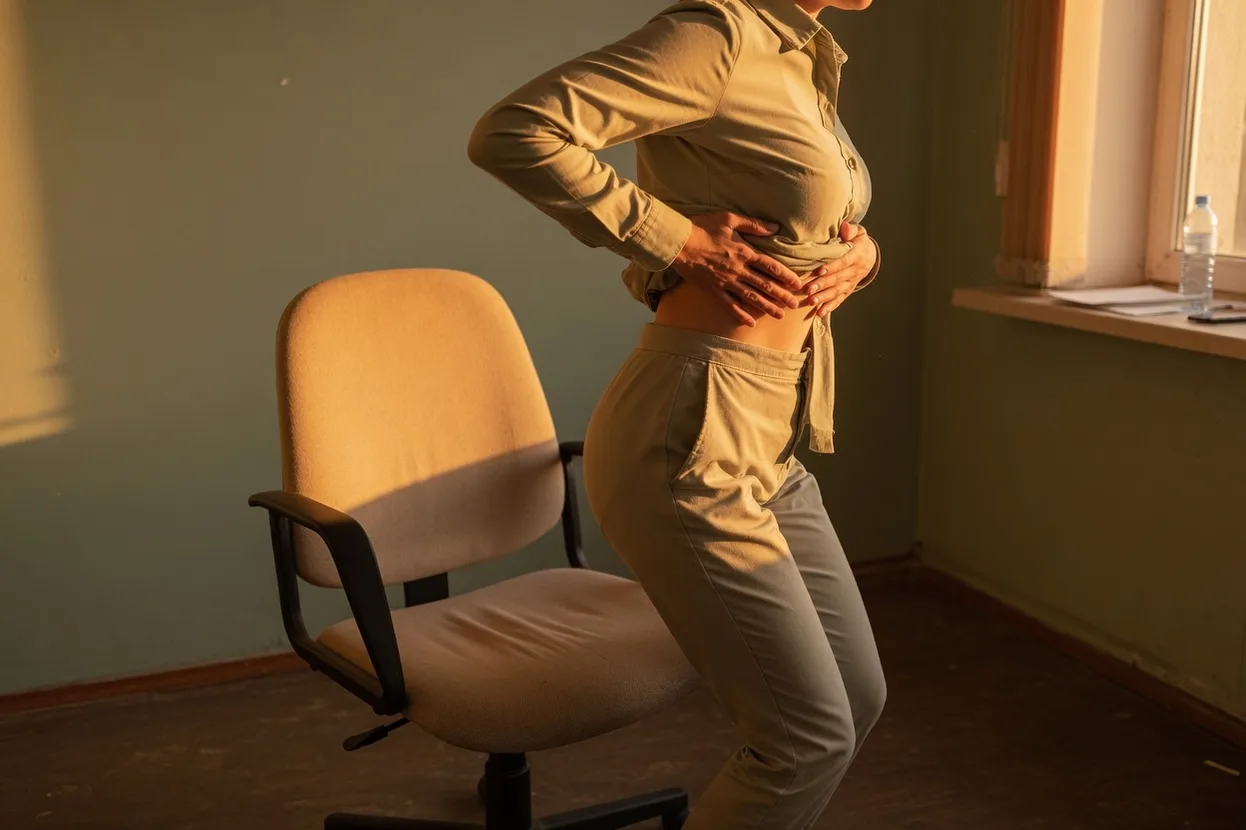
The zipper on the linen shirt stops halfway, right at the ribs. The shirt hangs from a coat hook in the hallway. The teeth below are still open. Belly breathing not working feels exactly like that. Breath reaches the ribs and then it is done. The belly wall barely comes along, even when you already know the instruction.
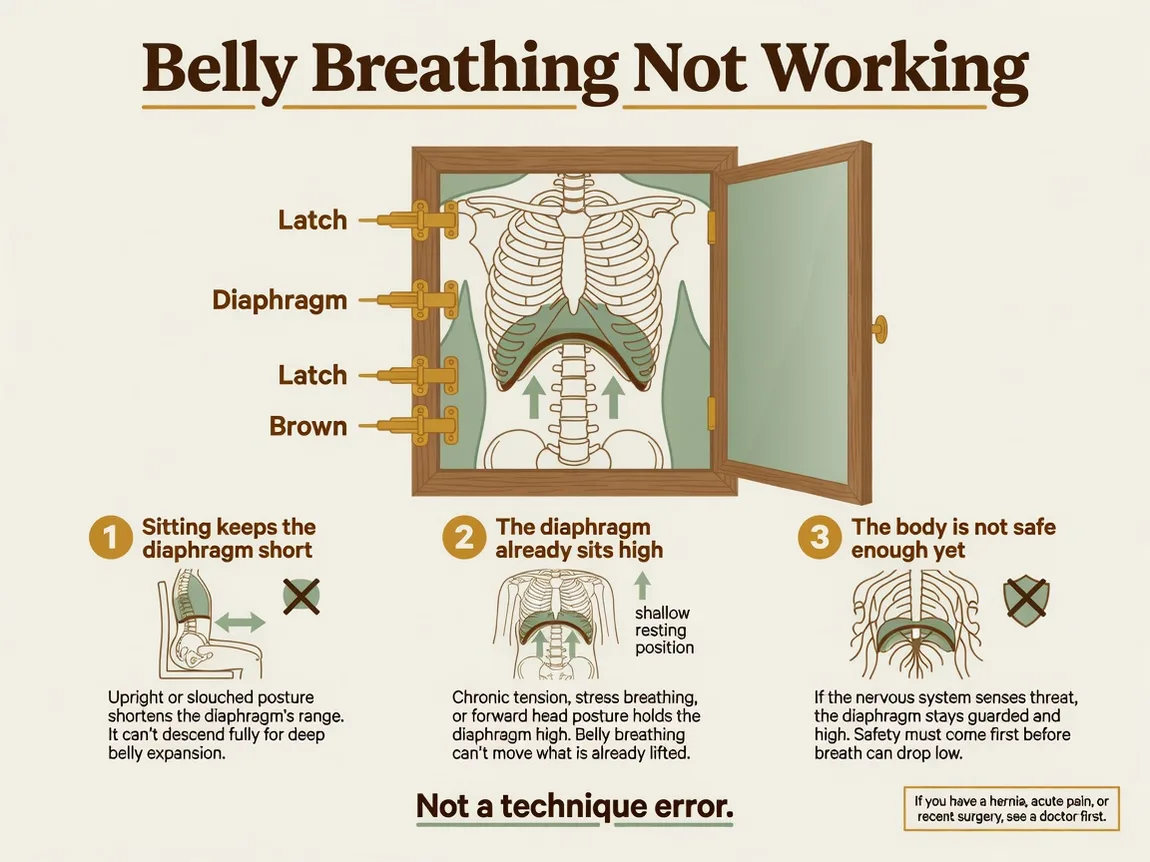
You stand there for a moment. Nobody asks anything. No mat. No counting. Just that shirt and a breath that stays in the chest. As if three latches sit on one door. The door is the movement toward your belly. The latches are sitting, a diaphragm that already sits high, and a body still on watch.
Belly breathing that does not land is breath that stays in the chest while the belly wall barely moves, even when the instruction is clear.
Belly breathing not working: the first latch is sitting
A seat that shortens the diaphragm is a posture in which the hips fold and the belly wall gets little room, so breath has less distance to travel downward.
- Belly breathing that does not land
- Belly breathing that does not land is breath that stays in the chest while the belly wall barely moves, even when the instruction is clear. Sitting, a high diaphragm, or a body still on watch keeps the movement small. It is not proof that you are doing the technique wrong.
Back to that hallway. You lift the shirt off the hook and sit on the bottom step, because your shoes are there. The fold under your ribs closes at once. The zipper that was hanging open a minute ago would have nowhere to go. The same thing happens in an office chair. Hips tipped forward. Belly pinched. Breath stuck up high.
That is a posture limit. Not proof that you botched the exercise. Arzayus-Patiño and colleagues (2026) used ultrasound in 36 healthy adults to see how far the diaphragm moved at different trunk angles, from lying flat to nearly upright. The excursion increased up to seventy degrees. That was the largest movement in their setup. This is not an office-chair study and not a treatment. It only shows that trunk angle changes diaphragm motion in healthy people.
Stand for a moment, or lean back a little. Only notice whether the belly gets more room. Do not push anything forward. If sharp pain stays, stop and have that checked medically first. Shallow breath from sitting and the psoas covers that sitting latch in more detail. This piece stays with the phrase that brought you here.
You hang the shirt back up. The hallway is narrow. Light falls sideways across the linen. The zipper is still at rib height. One latch has been seen. Two remain.
The second latch: the diaphragm already sits high
A high diaphragm is a breathing muscle already drawn upward before you ask for a deep inhale, so the belly has little descent left to offer.
Same coat hook. You stay standing this time. Hands at your sides. You ask nothing of your breath. Still the movement sits high, as if someone set the zipper at the ribs in advance. The belly is not lazy. The muscle above it has already used the room.
People often call that a technique error. "You have to push your belly forward." Pushing does not lengthen the zipper. It stiffens the belly wall. Breath then hunts the chest even faster, because at least something still moves there.
You notice it in small things. The lower ribs barely widen. The belly stays flat on an ordinary inhale. After a sigh something drops, and it pulls back up at once. No drama. A pattern, though.
Pro-tip: Name only what moves, ribs or belly. Do not push the belly forward to make the picture match the cue.
Breathwork is about that room, not a prettier performance. A timer can help one exhale grow long enough without turning into a program. The free breathing timer is enough for that. One quiet exhale. Not a round of five.
The third latch: the body is not safe enough yet
A body that does not feel safe enough yet holds the breath high, as if something still needs watching, even when the room is simply quiet.
Third time in the same hallway. The shirt hangs. You stand. And before you even take a deep inhale, jaw, hands, or pelvic floor already tighten a little. Small. Almost polite. The body is not saying you failed the exercise. It is saying: stay small for a bit longer.
Sometimes you only notice when you put your shoes on. You bend, and the breath jumps up. You stand tall, and it drops a centimeter. Nobody gave you a cue. The shirt on the hook does not move. You do, a little, and the latch moves with you.
That difference is enough for today. You do not have to fix the seat with a new method. You only have to see that the door was already closing before the instruction started. A lesson on connected breathing and the nervous system goes further into pace and safety. Here it stays with the three latches on this one door.
Stress, long strain, or an old startle can keep that small breath in place. That is recognition. Not a diagnosis, and not a story I will fill in for you. Moffat, Walker, Fuld, and Higgins (2026) looked through 62 reports up to May 2025 on living with a breathing pattern disorder. Stress shows up often as a trigger. The authors themselves say the evidence is thin, mostly Western, often old case reports, and that no agreed definition exists. So this is not proof that an "unsafe body" causes your belly breathing to stall. It is an honest note that strain and breathing pattern are often named together in the literature.
The trauma angle of hips and psoas belongs in another piece, psoas, emotion, and hips. Here safety stays one latch. Not an essay. If the breath has stayed high for a long time and you want a person instead of a timer, breathwork coaching is the door. No session price on this page. Someone who looks with you.
If it gets tighter the moment you try to go deeper, stop. One exhale that lengthens on its own is enough when the body stays soft. No counting.
Slower breathing is not a key for all three
Slower breathing is a shift in pace that can raise heart rate variability in healthy adults, without making the belly join in on its own.
You know the promise. Four counts in, six out, and the belly follows. Sometimes it does. Often it does not, if one of the latches is still shut. The shirt in the hallway does not get longer because you pull the zipper more slowly.
Giorgi and Tedeschi (2025) reviewed six studies on slow breathing and heart rate variability in healthy adults aged 18 to 60, without major heart, lung, or neurological disease. In those six studies the high-frequency component rose in particular. A longer exhale was linked with more rhythmic swing between heart and breath. The protocols are not standardized and long-term measures are missing. This does not prove that belly breathing works the moment you breathe more slowly. And not in people whose breath stays small because the body is still on watch.
Look first at which latch is shut. Pace means something only after that.
| Latch | What you notice | What it is not |
|---|---|---|
| Sitting keeps the diaphragm short | In the chair the belly stays quiet, standing there is a bit more room | Not proof that you followed the instruction badly |
| The diaphragm already sits high | Movement lives at the upper ribs, even when you force nothing | Not a lazy belly you should push forward |
| The body is not safe enough yet | Jaw, hands, or pelvic floor tighten before the deep inhale | Not a trauma story and not a promise that one breath fixes it |
Five things you only notice
This is not a plan and not a protocol. Five points of recognition, short, at the end. The practices themselves stay in the guide.
- Notice where the breath stops when you sit, and where it stops when you stand. Do not correct anything yet.
- Name only what moves: ribs or belly. Do not push the belly forward.
- Feel whether jaw, hands, or pelvic floor already tighten before you ask for a deep inhale. If they do, leave that request for a moment.
- One exhale that lengthens on its own is enough if the body stays soft. If it gets tighter, stop.
- Hernia, acute pain, or recent surgery: do not practice, see a doctor first. This article is not treatment.
The psoas guide is a paid ebook, not a substitute for care. Launch price €14.95 until 18 November 2026, then €29.95. This article explains the three grounds. It does not empty that protocol.
Pro-tip: If the hallway is quiet and your breath still stops at the ribs, the next step is seeing which latch is shut, not a heavier technique.
How breath and posture meet in a class is also in breathing in yoga. Different angle. Same body. The posture itself, without a breathing cue added, belongs with yin yoga.
Key takeaways
- Belly breathing not working is usually not a technique error. Breath stays in the chest, and the belly barely gives.
- Latch one: sitting folds the hips and keeps the diaphragm short. Stand or lean back a little. Do not force it.
- Latch two: the diaphragm already sits high. Pushing the belly forward stiffens the wall.
- Latch three: a body on watch keeps the breath small. That is not a trauma story filled in for you.
- Slower breathing can shift heart rate variability in healthy adults, but it does not open a shut latch by itself.
- Hernia, acute pain, or recent surgery: see a doctor first. The psoas guide is a guide, not care.
The shirt stays on the hook. The zipper stops where it stops. You do not have to pull it any farther today.