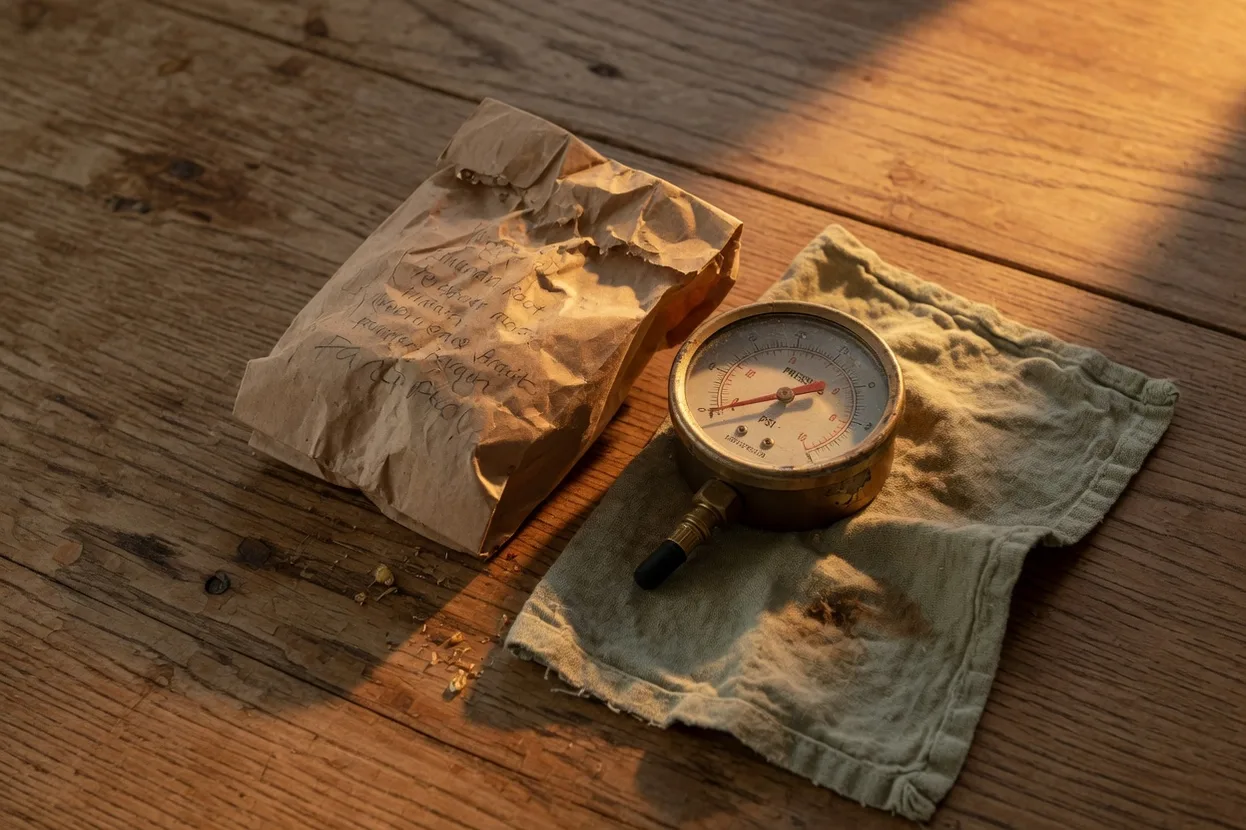
Breathing for anxiety starts here with a paper bag and an analog gauge on the kitchen table, not with a will that has to push harder. The bag is brown and crumpled. Someone once held it to a mouth, or kept it in a drawer for the next time the breath ran off. The gauge lies beside it. Needle near zero. Oak, amber light, a sage linen cloth. No mat. No closed eyes. Two objects naming the same problem: the breath is running too hard, and there is no character knob that shuts that flow.
You know the pace. The chest rides higher. The sips get shorter. The head counts along, as if counting were the same as steering. Then the dizziness, or the tingling, or only that odd emptiness behind the eyes. Breathing for anxiety, in that minute, is not an exercise menu. A disorder does not vanish tonight because a page explains a cycle. You can still read the chain the way you read a gauge.
Breathing for anxiety: the valve, not the will
Breathing for anxiety means slowing rate and volume so the CO2 buffer and the chemoreceptors do not drive the alarm any further.
- Breathing for anxiety
- Breathing for anxiety means slowing rate and volume so the CO2 buffer and the chemoreceptors do not drive the alarm any further. It is a bodily chain, not a character test.
A gas valve meters flow. It does not judge. Your breath does the same thing when anxiety climbs: more air per minute, less carbon dioxide left in the buffer, a different signal to the sensors that feed the breathing center. The bag on the table is an old folk trick for that buffer. The gauge is the picture I prefer. You can see whether the flow is high. You cannot see whether you are a good person.
Willpower sits in another drawer. You can talk to yourself until you are hoarse. Blood-gas chemistry listens poorly to that speech. Slow breathing takes rate and volume. Not a moral report card.
This piece explains that chain. Acute tools live in three breathing exercises for a panic attack. The technique of connected breathing, with rhythm and pauses, lives in the beginner's guide to connected breathing. No third menu here. Physiology, so you can see why a softer flow sometimes quiets the alarm, and why that is not a cure.
People who say breathing does nothing have often already tried everything in top gear. Faster counting. Deeper gulps. An app that beeps while the chest is already up. The valve is still open. More instruction does not shrink the flow. See what the gauge is doing first. Then pick a pace that does not empty the buffer any further.
The hyperventilation cycle in plain language
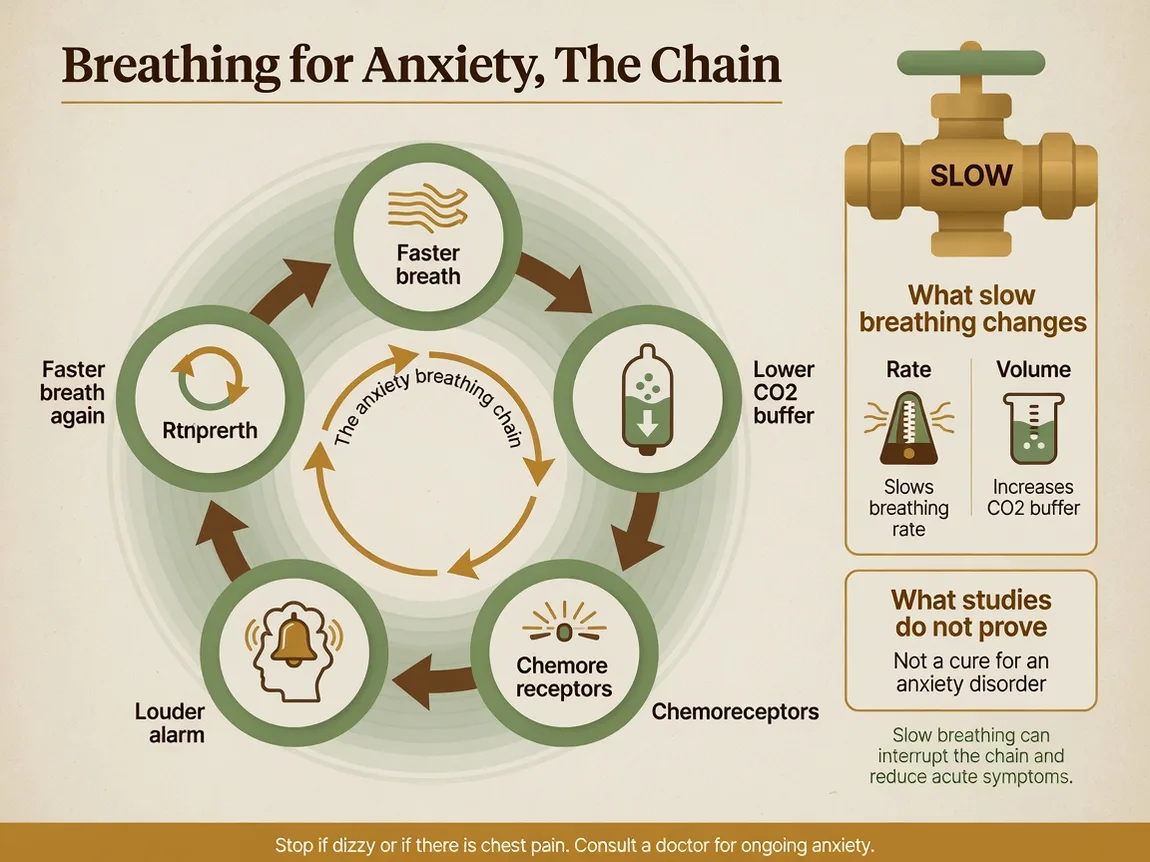
The hyperventilation cycle is the chain in which faster breathing drops the CO2 buffer, chemoreceptors feed the alarm, and the breath speeds up again because of that.
- Hyperventilation cycle
- The hyperventilation cycle is the chain in which faster breathing drops the CO2 buffer, chemoreceptors feed the alarm, and the breath speeds up again. Slow breathing acts on that chain. That is not proof of a cure.
Picture a pot of soup on a high flame. You stir faster, hoping the stirring will tame the boil. The flame stays. With anxiety, air behaves in a similar way. You blow off extra CO2. The buffer, the store that absorbs swings, gets thinner. The alarm reads that thinner buffer as danger. The breath speeds up again. Loop closed.
In the body it is specific. Tingling fingers. A tight jaw. A head lighter than the room. Some people reach for the paper bag then, because rebreathing brings a little of that blown-off CO2 back. This text is not medical advice to do that. The picture still holds: the problem sits in the buffer, not in a shortage of courage.
| Step in the chain | What the body does | What it is not |
|---|---|---|
| Faster breath | More air per minute, extra CO2 out | A character flaw |
| Lower CO2 buffer | Less margin for the next breath | A diagnosis by itself |
| Chemoreceptors | A louder signal to the breathing center | Willpower failing |
| Louder alarm | The breath speeds up another notch | Proof that you cannot do this |
The table is a reading aid, not a protocol. Four steps, one circle. Slow breathing softens the first step. Rate down. Volume down. The rest of the circle gets less fuel. Whether that works for you today depends on how high the gauge already sits, and on whether something medical is in the mix. More on that below.
If you want to hold the pace without counting until your head joins in, a free breathing timer can keep the beat. Only when the cycle is mild. Not when the room is spinning.
Chemoreceptors and the shifted curve
Chemoreceptors are sensors that read the mix of gases in your blood and send the breathing center a louder or quieter signal.
You do not feel them as a spot you can point to. You feel the result. The breath wants another sip when you just exhaled. As if the room had too little air, with the window open. That feeling is real. It is also a measurement, not a story you invented to be difficult.
A 2026 case-control study looked at twelve people with idiopathic hyperventilation and twelve matched controls. Research on that shifted CO2 curve found higher baseline ventilation, more breath drift, and a curve shifted left: lower thresholds, a wider peripheral sensitivity range, less buffering. Controller gain was similar. The sensors were set more sensitive. The store was thinner.
What that study does not prove: that one exercise reverses the syndrome. There was no breathing intervention. Twelve versus twelve explains the chain. It is not a treatment trial. I use it as a gauge, not as a recipe.
For the wider alarm in the nervous system, it helps to keep the vagus nerve separate from this CO2 chain. That nerve belongs with rest and recovery. In the studies below it was not always measured. The buffer was, or the anxiety score was. Do not mix those layers, or you promise a route the lab did not walk.
Pro-tip: Sketch the four steps on a scrap of paper next to your timer. Faster breath, lower buffer, chemoreceptors, louder alarm. Once you can see the circle, you do not have to beat it with your character.
What slow breathing changes in rate and volume
Slow breathing turns two knobs on the gas valve: how often you breathe, and how much air passes with each breath.
Not the meaning of the fear. Not the memory under it. Not whether you will have the same worry tomorrow. Rate and volume. That sounds small. On a gauge, small is the unit that counts. A needle that drops two marks is not a miracle. It is a different setting.
In a lab with 27 healthy participants, a study of slow versus fast breathing compared those two paces under certain and uncertain threat. Slow breathing went with lower anxiety, lower valence, and lower arousal. EEG power rose across several bands during slow breathing. In the uncertain condition, beta fell with slow breathing and rose with fast breathing. Healthy people, a short task, no clinical anxiety disorder. No weeks-long treatment. The needle moved in the lab. That is not the same as a disorder being cured.
A smaller study, seventeen healthy participants, had people breathe in for four seconds and out for six, against their resting breath. Anxiety scores sat lower after that slow breathing, including after unpleasant images, and midfrontal alpha asymmetry rose. Heart-rate variability and exhaled CO2 were measured. I will not invent an effect that is not in the summary. Small sample. Acute task. Not treatment for an anxiety disorder.
A pilot in young adults placed three minutes of slow breathing before reappraising negative pictures, against no breathing exercise. The unpleasant charge of the images dropped, and people reported more success at regulating. The authors mention a vagal route as a possibility. They did not measure the vagus nerve directly. Pictures are not a panic attack on the kitchen floor. A pilot stays a pilot.
Four sources, the same ceiling. They show that pace does something to scores and to signals. They do not show that you lose a diagnosis tonight. Skip that limit and the gauge becomes a brochure.
Four studies, and what they do not prove
A study proves what it measured, in the group it measured, in the minutes it clocked.
Lab work through 2026 shows lower anxiety scores after slow breathing. Often in healthy participants. Often after minutes, not months. The case-control shows a shifted curve in a small group with a hyperventilation syndrome, with no exercise inside it. Put those side by side and you get a mechanism plus a short shift. You do not get a therapy that replaces care for an anxiety disorder.
No mouse study sits in this set. That does not shrink the limit. Healthy volunteers are not clients with a disorder. Watching a curve is not a trial. A pilot with pictures is not emergency care. I write that because trust lives in the boundary, not in a louder claim.
If you understand the chain and still cannot turn it alone, guidance sometimes fits. Look at breathwork coaching, without a price or a promise riding along in this piece. The pillar for the wider account of breathwork is the breathwork guide. If you want to see whether your pattern under stress matches what you feel, there is a breath check. Not a diagnosis. A mirror.
The polyvagal layer, if you want it beside this without letting these CO2 studies prove it, is in polyvagal theory explained. Useful as a frame. Not as a lab result from the four sources above.
When the gauge is in the red
Slow breathing is not enough if you get dizzy, faint, have chest pain, or if anxiety blocks you for days.
Stop then. This is not a coaching moment. Get medical help. A timer holds pace when the cycle is mild. A blog does not sit watch over a chest that hurts. I want that sentence plain, not pretty.
Even when the room is steady, the cycle can be too hot for solo work. You understand the four steps and the breath still runs. That is information. Not a failure of the explanation. The valve responds to repetition, to context, sometimes to a body that has been in alarm for days. Guidance is a practical next step then, not an upgraded form of willpower.
Pro-tip: If the needle is in the red, put the timer down. Dizziness, fainting, or chest pain belongs with a doctor, not with a longer exhale.
What you can do on a mild day: say the chain once while your breath is already quiet. Not to perform. To recognize the gauge before it spikes. Rate. Volume. Buffer. Sensor. Alarm. Five words. The explanation does not need to grow past that.
Where to read the chain next
This page stops at the mechanism. The three acute tools stay where they belong, in the panic piece. Connected breathing stays a technique guide, not a physiology of the CO2 curve. Mixing them turns one chain into three menus, and then you are choosing while the needle is already moving.
If the cycle is soft enough to practice pace, use the timer. If you want to check whether the pattern fits your stress, take the breath check. If you understand the chain and cannot turn it alone, breathwork coaching is a place to do that with someone. None of the three is emergency care. None of the three cures an anxiety disorder because a blog wrote it down.
I leave the bag and the gauge on the table. The bag points at the buffer. The gauge points at a setting, not a verdict. Breathing for anxiety is shifting that setting where it can shift. The rest is care, time, and sometimes someone looking with you when the valve will not close on its own.
Key takeaways
- Breathing for anxiety slows rate and volume. It is not a character test and not an exercise menu.
- The hyperventilation cycle feeds itself: faster breath, thinner CO2 buffer, more sensitive chemoreceptors, louder alarm.
- A small 2026 case-control explains that shifted curve. It does not prove that one exercise reverses the syndrome.
- Lab studies show lower anxiety scores after minutes of slow breathing, mostly in healthy participants. That is not a cure for an anxiety disorder.
- Stop if you are dizzy, faint, or have chest pain, and get medical help.
- A timer, a breath check, and breathwork coaching are next steps for a mild cycle, not an emergency protocol.