
Breathwork in relationships starts with two mugs, not with a talk that has already gone wrong. One still throws a thin column of steam. The other sits flat, a pale ring along the rim. You hear your own breath only when his speeds up. Or hers. The room takes the tick, like a metronome nobody switched on.
That tick is not a fight. Not yet. It is pace. Pace arrives before the sentence.
Breathwork in relationships: two rhythms in one kitchen
Breathwork in a relationship is the way two breathing rhythms pull each other along, before anyone says the word conflict out loud.
You know the sound. Spoon on ceramic. A chair that shifts a centimetre. Then the other breath, shorter than five minutes ago. You were still on the shopping list. Now you sit higher in your chest. Nobody has said anything sharp.
- Co-regulation
- Co-regulation is the pattern in which one person's nervous system takes on the other's pace through breath, voice, gaze and closeness.
A character flaw? No. Proof the relationship is broken? Also no. It is a trace you can hear. Voice joins in. Silence joins in. The mug going cold is only the set.
I often sit beside someone, not opposite them. Face to face turns into a hearing. Side by side stays a kitchen. If you want to see the pace, you do not need a speech about love first. You only need to notice who picked up the count.
In breathwork you practice that on your own first. In a relationship you practice it while a second metronome stands in the room. That second one is not an enemy. That second one is a person with a day already behind them.
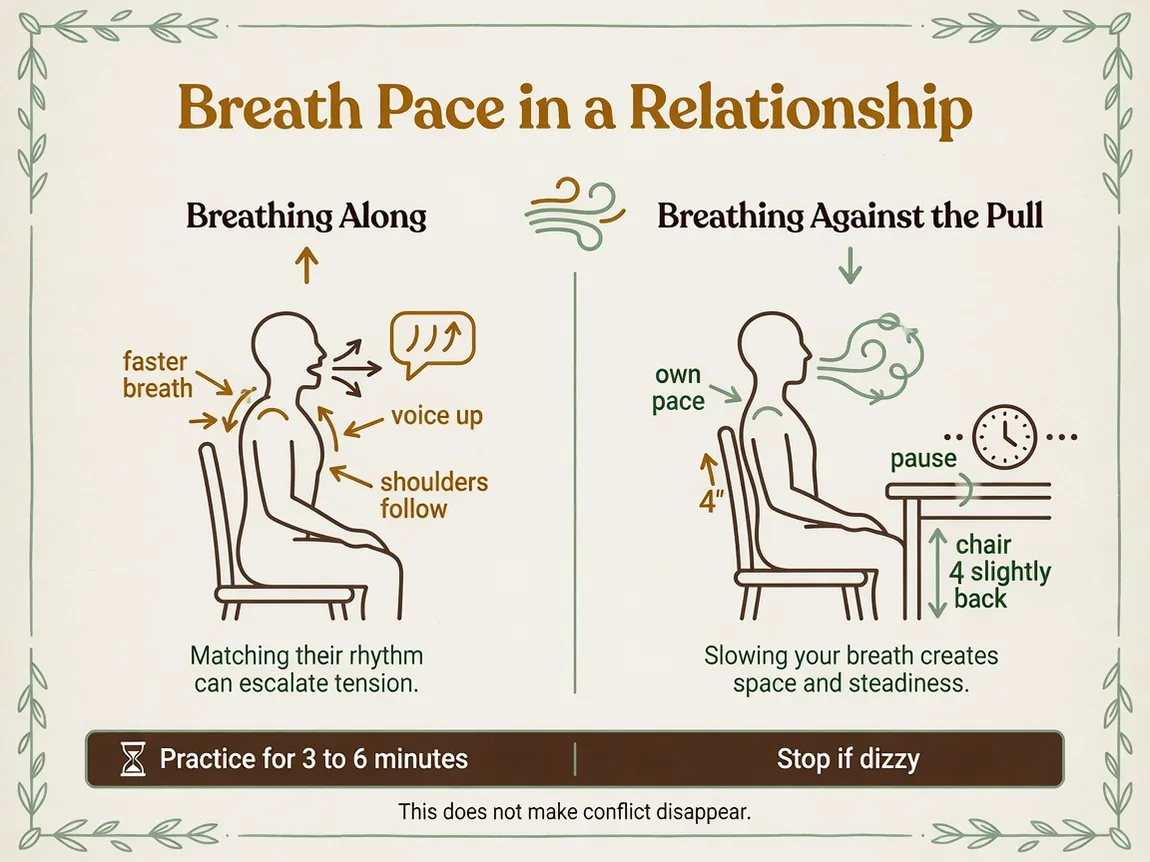
Breathing along is not a choice you say out loud
Breathing along feels like manners. Your voice climbs because the other person talks louder. Your shoulders follow. Your exhale becomes a short push, as if you have to catch a sentence that is not finished.
You decided nothing. Your body took the count.
A study of ordinary conversations found they go together with higher respiratory sinus arrhythmia. That sounds soothing, and it is a trace: talking with someone is already a bodily event, not only an exchange of opinions. What that study does not prove: that a breathing exercise ends a fight. It was not a couple intervention. Not a kitchen table after a hard day. Only this: a conversation tugs your rhythm, even while the words stay kind.
So it helps to name the pace before you finish the sentence. Not: you always do this to me. Rather: my breath just got shorter while you were talking. That is information. Not a verdict.
If you want a plain map of how bodies answer each other, polyvagal theory in ordinary language is there. Not an excuse. A map.
Pro-tip: If you hear yourself talking faster than you meant, put the spoon down. One exhale, longer than the sentence. Then the word.
What breathing together does and does not prove
Respiratory synchrony is two breathing rhythms lining up, and that lining up says nothing about whether the room is safe.
- Respiratory synchrony
- Respiratory synchrony is two breathing rhythms lining up. It can support closeness, but it does not prove a relationship is safe.
A lab study found that respiratory synchrony in pairs pulled behavioural synchrony along. Two people got the same task. Their breath lined up. Their movement followed. A clean trace. The limit matters: a lab task is not a romantic argument at half past six. Nobody had left the dishes. Nobody was afraid of the next sentence.
Another, preliminary study looked at stress transfer in community couples after a staged strain. One person's cardiac response showed up in the other. No breath protocol. No real fight at home. An analog. You still recognise it: you walk in, the other person is already high, and within a minute you are higher too. Not because you are weak. Because closeness is a channel.
You stay responsible for your own pace. Your partner is not a mirror who must absorb everything. The pattern is real. The blame split is not.
| What you notice | Breathing along | Breathing against the pull |
|---|---|---|
| Breath | Shorter, higher, matching the other | Your own count, four in and six out |
| Voice | Up, faster, catching the sentence | Lower, with a pause before the word |
| Body | Shoulders follow, chair forward | Feet on the floor, chair slightly back |
| Stop | Only when the sentence is done | As soon as someone feels dizzy or more alert |
Breathing against the pull means keeping your own count while the other person speeds up, without leaving the room and without correcting them.
Harder than it sounds. Correcting lives in a loving mouth. Slower, love. You mean well. The other body hears a referee.
One shared practice, not a menu
A shared breath pace is a three-to-six-minute agreement, side by side, in which stopping needs no explanation.
Sit next to each other. Not face to face. Feet on the floor. Agree that either person may stop without a story. That is the whole permission.
Breathe in for four counts and out for six. Soft enough for the other person to hear, not so loud that it becomes a demonstration. Whoever speeds up may drop back to a slower personal count. Do not correct. The faster breath may ease a little. The other person does not have to join a performance.
Three minutes is enough for a first round. Six is the top. Longer becomes a score. No app wins.
If you want a count outside your head, start the free breathing timer together. Only if both of you want the screen. A timer as referee makes the room smaller, not quieter.
Afterwards, each person names one word for the pace in the room. Tight. Hollow. Softer. Crooked. No five-minute debrief. Talk after that, or do not.
Pro-tip: If either of you feels dizzy, the practice is done. Dizziness is data, not proof you did it wrong.
Not everyone feels warmth or a soft wave afterwards. Some people feel only the chair. Or nothing special. That is a valid round. Other people's pretty stories are not a promise.
And if your body gets more alert after breathing together, that is information too. Not a failed exercise. Sometimes the body says: not closer, not now. Then you stop. Full stop.
Breathing together is not therapy for an unsafe house
There is research on nerve stimulation in couples during conflict, not on this kitchen practice. Real stimulation brought a larger drop in that breath-linked variability than a sham condition, with no difference in emotion. Synchrony of that reactivity did not differ between conditions. Important: that is a device on the skin. Not a four-six count beside the mugs. I will not pretend shared breathing does the same thing.
Co-regulation describes how bodies respond to each other. It does not replace a boundary, an apology, or outside help when coercion, contempt or fear lives in the house. Breathwork can make a conversation possible. It does not make an unsafe relationship safe.
If saying no already costs a whole breath, setting boundaries without guilt will serve you better than a longer round. And if you keep falling into the same pattern, you may recognise something in relationship patterns beyond the love languages. This piece is the pace. That piece is the story around it. Not the same thing.
A couple session with us lasts sixty minutes and costs €60. Not a vague intro that never lands. You sit side by side, we hear the pace, and you go home with one agreement you can repeat. That runs through breathwork coaching.
If breathing together makes the room more restless, write one sentence via contact. No guide. No download. A person who writes back.
If the steam on one mug is still rising while the other has already gone cold, you do not need to make that poetic. It is a clock. You choose whether you follow that clock or set your own count, three minutes, feet on the floor, chair slightly back. A first round does not need more than that.
Key takeaways
- Breathwork in a relationship is about pace, not about who is right.
- Breathing along happens before you decide. Name the breath, not the character.
- Three to six minutes side by side is enough. Stopping needs no explanation.
- Matching breath does not prove safety. Getting more alert after the practice is information.
- Lab studies are backing, not a kitchen table. A task is not a fight at home.
- A couple session is sixty minutes, €60, if you want to hear the pace together with guidance.
Warm regards, Tessa and Luna, on behalf of Spiriators