
You have already typed the search and still the cursor hovers. One tab shows a therapist's practice. Another shows a coach who works with breathwork. The question of coaching vs therapy is not whether something is wrong with you. It is what fits right now: processing, deepening, or something in between.
Many people arrive here after finishing a therapeutic path, or while they are still wondering whether they should start one at all. The language we use does not always keep therapy and coaching sharply apart. For the guidance you receive, and for the boundaries that come with it, the difference still matters. Spiriators does not offer therapy. What we offer is guidance through breathwork and awareness. That position calls for honest choice support, not a sales story. The brand frame is that we are already whole and remember rather than repair. That is not a claim of healing or a promised result.
What therapy is and is not
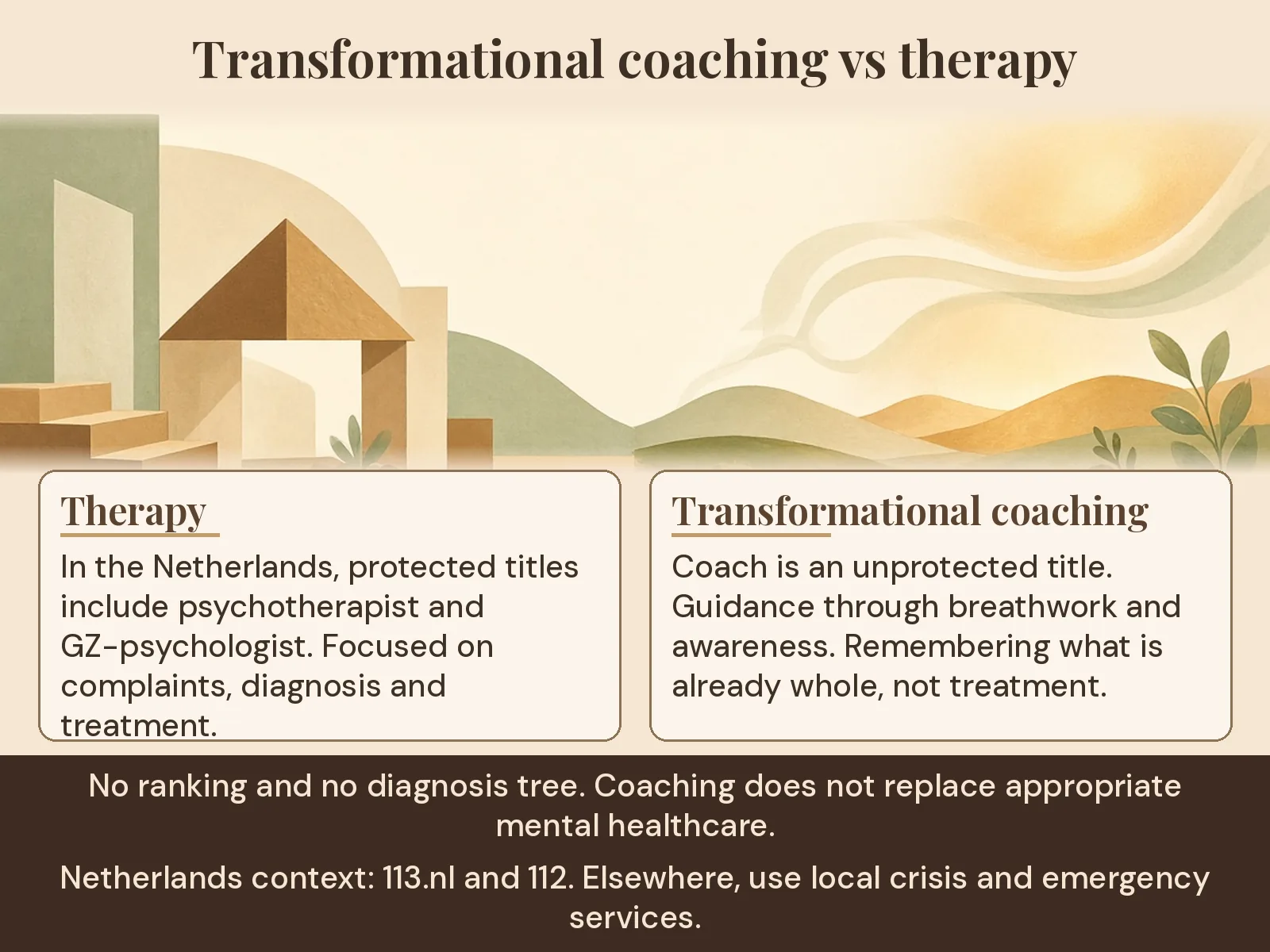
Therapy, in the sense of psychotherapy or treatment by someone with a protected title, focuses on understanding and treating mental health complaints or disorders. In the Netherlands, only the titles psychotherapist and GZ-psychologist are protected under the BIG framework, with legal exceptions. Those titles are protected. Other names in the wider field of support are not automatically protected. Elsewhere, protected titles and care routes differ; look at the rules that apply where you live rather than treating the Dutch frame as universal.
- Therapy
- In this article: support that focuses on mental health complaints or disorders, often with diagnosis and treatment within a care framework. This is not a complete description of the whole field.
The aim is often to ease suffering, process trauma or learn skills for living with a diagnosis. The length varies. Some paths are short and focused on a specific complaint. Others last longer and look more deeply at patterns someone has carried for a long time. The therapist is usually the person who holds the frame: what is safe, what is needed, and when a referral is required.
Therapy is not coaching, and coaching is not therapy. Anyone looking for treatment of an anxiety disorder, depression or trauma that severely limits daily functioning is usually better served by a registered practitioner. That is not a value judgement about coaching. It is a difference in task and authority.
Pro-tip: In a first conversation, always ask about the precise title and registration. In the Netherlands, only psychotherapist and GZ-psychologist are BIG-protected. Other titles can still be valuable, but they do not grant a legal licence to treat.
Transformational coaching: remembering rather than repairing
Transformational coaching, as it takes shape at Spiriators, starts from a different place. The brand frame is: we are already whole. The work is remembering, not repairing. That is not a claim that coaching heals, or that someone does not need treatment. It is a way of looking. The guidance focuses on awareness, on the breath as a way into the nervous system, and on exploring what is already present.
- Transformational coaching
- As used here: guidance through breathwork and awareness for a development question. No diagnosis, no treatment and no protected professional title.
A breathwork coach does not work with diagnoses. The title coach is unprotected. Anyone may use it. Quality then depends on training, ethics and the boundaries the coach actually keeps. Quality marks such as EIA from NOBCO are voluntary. At Spiriators the position is clear: we offer one-to-one guidance through breathwork and yin yoga, and we organise travel in which those practices are central. We refer on when a question falls outside our scope.
Imagine someone, let us call them Alex, who after a year of talk therapy for recurring stress still has the insights, yet notices that the body slips back into an old alarm state when work pressure rises. Alex is not looking for a new diagnosis. Alex is looking for a way to return to calm in the moment. This is a hypothetical example of a situation in which breathwork guidance may fit alongside or after therapy, not as a replacement.
You can read more about the practice of breathwork coaching in the piece on why you remain a beginner in this work: breathwork coaching: always a beginner.
Pro-tip: Write down what you already know about yourself and what you still want to explore. That helps you see whether you are looking for treatment or for guidance in awareness.
Five differences that matter
The differences are not absolute. They do help you see where the focus lies. People who search for life coach vs therapist are often circling the same choice: support that treats, or support that accompanies a life question without diagnosing it.
| Aspect | Therapy | Transformational coaching (breathwork and awareness) |
|---|---|---|
| Starting point | A complaint, diagnosis or disorder | What is already whole and may be remembered |
| Aim | Treatment and relief of suffering | Awareness and embodiment of what is already present |
| Authority | In the Netherlands: BIG protection for psychotherapist and GZ-psychologist | Coach is an unprotected title; ethics and boundaries of the guide |
| Method | Conversation and interventions within a treatment framework | Breathwork, yin yoga, awareness practices |
| Referral | To other specialists or back to a GP or local primary care professional | To a registered practitioner when the question is clinical |
Research on workplace coaching describes positive outcomes for goals such as wellbeing and performance. One example is the study by Theeboom, Beersma and van Vianen (DOI: 10.1080/17439760.2013.837499). Those findings apply to non-clinical groups in an organisational context and say nothing about the treatment of mental disorders. Workplace coaching studies are not clinical and should not be used as evidence for therapy or breathwork.
Pro-tip: Save the table and place your own question beside it. See which column that question belongs in most clearly. Do not use the table to diagnose yourself.
Coaching vs therapy: choice support without a diagnosis
The choice is not always clear-cut. Sometimes a combination fits. Sometimes it is clear that therapy should come first. The questions below can help. They are not a diagnosis tree and not advice.
- Are you looking for support with trauma, or treatment of a disorder that limits your daily functioning? Then a registered practitioner is usually the first step.
- Do you already have insights from therapy and want to embody them now, for example through the breath or through yin yoga? Then guidance through breathwork may fit.
- Are you unsure whether your question is clinical? Talk it through with a GP or another local primary care professional who can help you find the right route.
- Do you want to know whether breathwork and yin yoga suit you without starting a longer path straight away? An introductory conversation can bring clarity.
In a crisis or acute emergency in the Netherlands, call 112 or go to 113.nl. Elsewhere, use your local crisis and emergency services.
You can read more about forms of breathwork in the breathwork guide. The meaning of a retreat is explained on the page what a retreat is. Those pages offer context, not a booking promise. Yin yoga and co-travel are services that, alongside conversation, offer a body-based or travel-based form of guidance, not a clinical setting.
Pro-tip: Write the questions down and answer them for yourself before you plan a first conversation. That makes the conversation sharper.
When both can be useful
Therapy and coaching do not always exclude each other. Someone may finish a therapeutic path and later use breathwork to let insights land in the body. Or someone may work, in parallel and with the practitioner's agreement, with body-based practices. The boundary is that the coach does not take over the treatment.
At Spiriators that boundary is clear. We offer online breathwork coaching and online yin yoga, both one-to-one. We also organise co-travel in which yoga, breath and coaching come together. Those journeys are not a clinical setting. They are another context for the same work of remembering.
The link to online breathwork coaching is here: online breath coach. Yin yoga is at online yin yoga. Co-travel is at yoga travel and nomadic co-travel.
Online breathwork coaching is there for anyone who wants to work one-to-one with the breath. Online yin yoga is there for anyone who wants slow postures as a way in. Co-travel is there for anyone who wants to live those practices in another environment, not as a clinical admission but as a journey in which yoga, breath and coaching meet. The pages describe what is offered, not what the result will be.
If you have been working with awareness for a while, you may recognise the thread of Eckhart Tolle in coaching. That piece is about presence as a guide, not about treatment. The link: Eckhart Tolle in our coaching.
Setting boundaries without guilt is a theme that appears in both therapy and coaching. The piece is here: setting boundaries without guilt.
The inner critic as an ally rather than an enemy is another related theme: turning the inner critic into an ally. That is not a therapeutic technique. It is a way of looking that can be explored in coaching. A skill practised in therapy can later be embodied in daily life, without coaching taking over the treatment.
Pro-tip: If you are already in therapy and want to add breathwork, discuss that with your treating professional first. They know your history.
The choice between coaching and therapy often lives in a grey area. Someone may notice complaints that have not been diagnosed as a disorder, or that have, and still feel that conversation alone is not enough. The body holds the tension even when the thoughts are already clearer. In those cases breathwork and yin yoga are not treatment. They offer another entrance: through the breath toward the nervous system, through slow postures toward the places where tension settles.
That entrance asks for realism. Not everyone is ready for body-based practices at the same moment. Sometimes stabilisation is needed first within a therapeutic frame. Sometimes the question is whether insights that are already there may now land in the body as well. In that light, the Spiriators frame is an invitation to look at what is already present. It is not a promise that the complaints will disappear.
A practical way to explore that question is to look at your own history. Does someone already have a diagnosis and a treatment plan? Then the treating professional is the right person to decide whether additional practices are safe. Does someone have no diagnosis and mainly want ways to meet everyday stress through the breath? Then a breathwork coach may fit. The boundary is not always hard, but it can be named.
An introduction is not an obligation. It is a conversation to see whether the guidance fits. The contact page is here: contact, plan your free introduction. The title on the site mentions that possibility. Whether it fits is yours to decide.
What fits you, when you are weighing coaching vs therapy, is not a question a blog can answer. It is a question you can ask in a conversation, with a practitioner or with a coach who keeps clear boundaries. The distinction between therapy and transformational coaching helps you ask that question more sharply. Not to persuade anyone, but to choose with more clarity.