
You cannot think your way into the now. You can only breathe into it.
That sentence captures what Eckhart Tolle coaching means to us. For years we read The Power of Now and A New Earth as books that loosened something in us without us being able to name exactly what. Until we started noticing what happened in our sessions when clients stopped talking about their thoughts and began breathing through them. That is when Eckhart Tolle's two books became our guiding line: not as theory, but as a protocol for breathwork and body-oriented coaching.
This is not a book review. This is a look inside how we work: how the ego, the pain-body, presence and the now form the operational core of our sessions. And why the breath is the bridge between a concept you understand and an experience that changes you.
The book that became our guiding line
The Power of Now entered my life at a moment when, on the outside, I had every reason to be content — and still I missed something I could not name. As a former submarine officer I was trained to function under pressure: focus, control, thinking ahead. Exactly the skills that keep your mind extremely active, long after there is any emergency left to solve.
What Eckhart Tolle describes — the voice in your head that keeps talking — I recognized immediately. Not as philosophy. As a description of my own daily experience. And A New Earth added something to it: the insight that the ego does not only hide in thoughts, but in patterns, in roles, in the way you react to everything life brings you.
But here is where many people get stuck, and where we got stuck ourselves: you can understand it all, chapter by chapter, and notice nothing of it in your life. Insight without bodily experience remains an idea. That gap — between knowing and being — is exactly where our coaching begins.
You are not your thoughts (and that is harder than it sounds)
The core of Tolle's work fits in one sentence: you are not your thoughts, you are the presence that perceives them. It sounds simple. Try sitting with it. Most people who sit still for the first time discover that their mind does not go quiet — it gets louder.
The ego is the identified voice in your head: the story of who you are, built from past and future, sustaining itself through repetitive thoughts. In A New Earth, Tolle calls those repetitive thought patterns viruses of the mind. Thoughts that solve nothing but keep circling, and that keep your identity intact because you keep believing them.
In our sessions we hear them every day: I am not good enough, it will go wrong anyway, I have to earn it first. Not as statements someone makes, but as background noise so familiar that nobody hears it anymore. Breaking through does not start with arguing — you cannot win a debate with a voice you have mistaken for yourself. Something else works: learning to see that you are not the voice.
It helps to know this movement is not just spiritual language. In a randomized study among veterans with chronic pain, a mindfulness-based training evoked self-transcendent experiences — moments in which the boundary of the self temporarily dissolves, significantly more often than in the control group receiving regular psychotherapy. That is exactly the movement Tolle points to: not improving the ego, but learning to look through it.
The pain-body: what we literally see happen in sessions
A New Earth introduced a concept that became literally visible in our practice: the pain-body. We first encountered it with a client who, halfway through a calm breathing session, suddenly became angry. Not at us. Not at anything in the room. At something that had happened twenty years earlier and announced itself through her body in that moment.
- Pain-body
- The pain-body is Tolle's term for stored emotional pain from the past that activates through triggers and temporarily takes over your thinking, feeling and reacting.
What we witnessed next changed the way we work. When someone drops into old pain, we do not treat it as a character trait or a setback. We recognize the pain-body — not the person. The difference is everything: whoever identifies with the pain fights it or drowns in it. Whoever recognizes the pain can stay with it without becoming it.
Science confirms what we see in the room: how well you feel the contact with your body determines how you process emotions. A study on interoceptive awareness — the ability to perceive signals from inside your body showed that this awareness is directly linked to emotion regulation and to the severity of symptoms such as anxiety and depression. The body remembers what the mind has forgotten. That is why talking alone often does not work — and why breathwork reaches something talking cannot: it brings your attention exactly to where the pain lives.
Presence: the concept you cannot think
- Presence
- Presence is the state of consciousness in which you are not identified with your thoughts but are the silent witness of what is — accessible through the body and the breath, not through thinking.
This is where we got stuck ourselves, and where most readers of Tolle get stuck. Presence is not a concept you grasp; it is a state you experience. You can read about it endlessly and still be entirely inside your head. Tolle's entire work revolves around one question: how do you move beyond thinking, when thinking seems to be the only instrument you have?
We did not find the answer in more books. We found it in the body. The body is always in the now — you cannot breathe in the past or in the future. Every time your attention moves to the breath, you automatically leave the stream of thought. Not because you have solved it, but because you have stopped feeding it for a moment.
Breath as portal: from thinking to presence
Breath is the portal to the now because you cannot breathe in the past or the future — every conscious breath returns your attention to the present moment. This is where Tolle's philosophy and our breathwork practice meet. In our sessions we do not use the breath as a technique to get somewhere — not to relax, not to reach an altered state. The breath is the way back to the space before the voice.
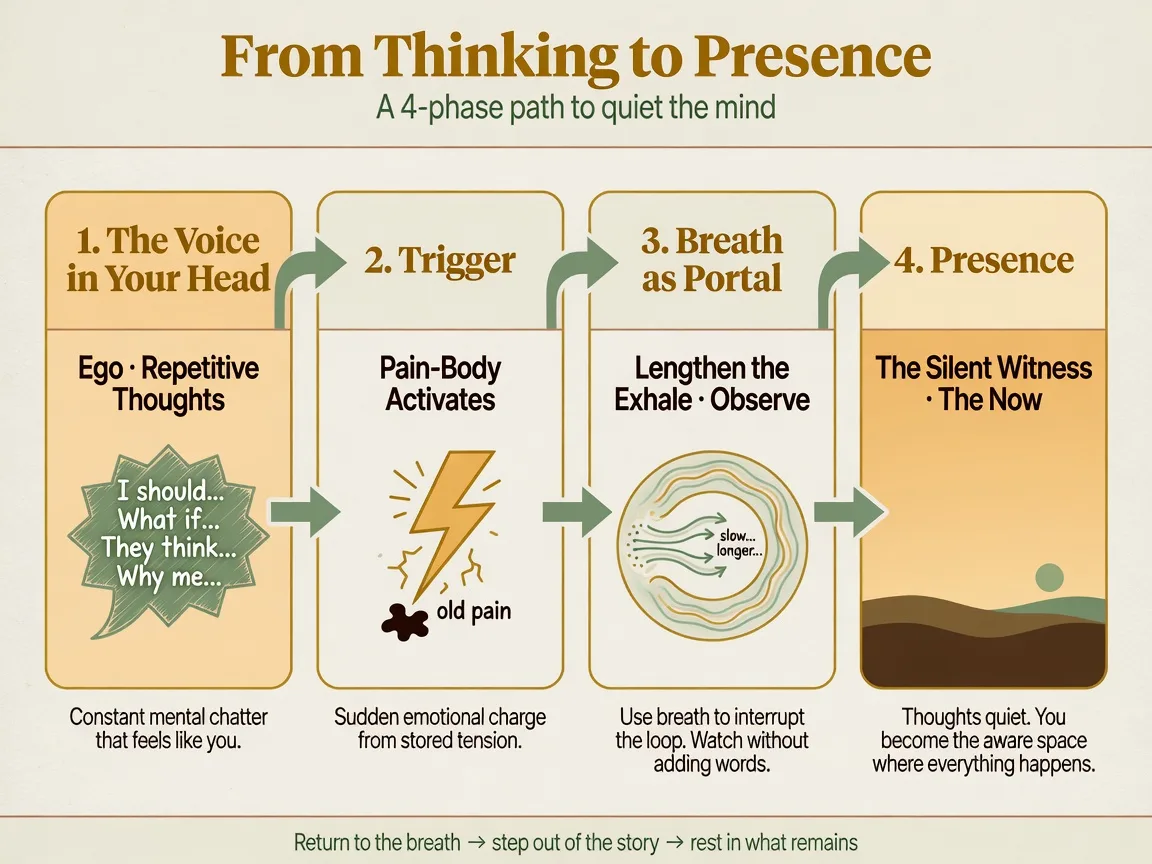
We see four phases return, again and again, in ourselves and in every client:
- The voice in your head — the ego runs its familiar loops, mostly unnoticed.
- The trigger — something touches the pain-body; the emotion feels bigger than its cause.
- Breath as portal — lengthening the exhale and observing interrupts the loop.
- Presence — the silent witness that was always there takes the place of the commentary.
That this is not a vague idea shows up in research. In a randomized waitlist study on conscious connected breathwork, participants' anxiety symptoms decreased significantly — without anything being done to the thoughts themselves. The breath changed the state in which the thoughts were happening. That is exactly what we mean by: not thinking about the now, but breathing into it.
Eckhart Tolle coaching in practice: the protocol behind a session
Concretely: what happens in a session? No lecture about The Power of Now. Instead, a body that learns what presence is. These four concepts together form our protocol:
| Tolle concept | How it shows up in a session | What we do |
|---|---|---|
| Ego (the voice) | Repetitive thoughts: this will not work anyway, I am doing it wrong | Name the voice without following it — breath as anchor |
| Pain-body | Sudden emotion at a trigger; tension in chest, belly or jaw | Recognize the pain as pain, not as the person — bring breath to it |
| Viruses of the mind | Thought loops that sustain identity | Interrupt the loop with one long exhale |
| Presence | Silence, space, the feeling of truly being here | Strengthen it by keeping attention in the body |
Presence over technique: that is the order. Not doing, but being. Whoever reads Tolle and thinks: I understand it, but I do not feel it — our method is meant exactly for that. In our blog on presence as a lifestyle you can read how this presence takes shape outside the session too, and in living in the now we explore what it means that your body is temporary — and your presence is not.
Five exercises to apply Tolle today
You do not need to meditate for hours to practice this. These five exercises take less than ten minutes in total — and they all begin with the breath:
- Breath as portal (3 min) — Sit down, place your hands on your chest and observe only your exhale, without steering it. Every time a thought carries you away, return to the exhale. This is not a relaxation technique; it is a return to the now. Our free breathing timer helps you hold the three minutes without watching the clock.
- Recognize the pain-body — Do you shoot into emotion at a trigger? Say inwardly: this is the pain-body, not who I am. Labeling without judgment takes you out of identification and opens space.
- The space before the voice — Observe a thought as if listening to it from a distance and ask: who is hearing this thought? The answer is not a thought. Breathe into that space.
- Interrupt viruses of the mind — When you notice a repetitive thought loop, interrupt it consciously with one long exhale. The loop is not solved by thinking, but by pausing thought.
- Presence in the body — When tension arises, scan your body from the inside: where do you feel it? Not to relax, but to experience. Breathe into the place that announces itself.
Pro-tip: Do the first exercise at a fixed moment — right after waking up or just before dinner. You do not practice presence whenever it suits you; you practice it until it becomes your anchor.
Why invest time in this? Because presence is not a luxury. An analysis of meditation research connects self-transcendence to fundamental human needs — the same category as connection and meaning. The longing for space in your head is not a spiritual extra; it is your nervous system asking for what it needs. Recognizing how that voice works touches the same territory as our work with the inner critic: the same voice, a different name.
Pro-tip: The goal of presence is not to lose your thoughts. The silence you seek is not behind the voice — it is the space in which the voice appears. Do not breathe to get rid of the voice, but to become the space in which it may exhaust itself.
Key takeaways
- Eckhart Tolle's work is not theory to us but a protocol: ego, pain-body and presence form the operational guiding line of our coaching.
- You are not your thoughts — you are the presence that perceives them. Breath is the fastest way back to that witness position.
- In sessions we recognize the pain-body as stored pain that activates through triggers: the body remembers what the mind has forgotten.
- Presence cannot be thought, only experienced — the body is always in the now, the mind is not.
- Viruses of the mind — repetitive thought loops — are not interrupted by more thinking, but by one long exhale.
- Three minutes of conscious breathing a day is enough to taste what presence is: not thinking about the now, but breathing into it.
Next step
If Tolle's words touch you but you do not yet feel them in your body, you are not the first. That is not a shortcoming — it is exactly the point where reading turns into experiencing. That is how Eckhart Tolle coaching becomes more than a book on your shelf: a way to breathe, to feel and to be.
In a 1-on-1 breathwork session we translate presence into your body: no lecture, but experience. Would you rather first explore, without obligation, where you get stuck between thinking and feeling? Plan a free introduction. And if you long for days in which breath, presence and silence come together: we take people with us on our travels and retreats.
Tolle wrote that the now is the only thing that ever exists. We breathed into it. So can you.