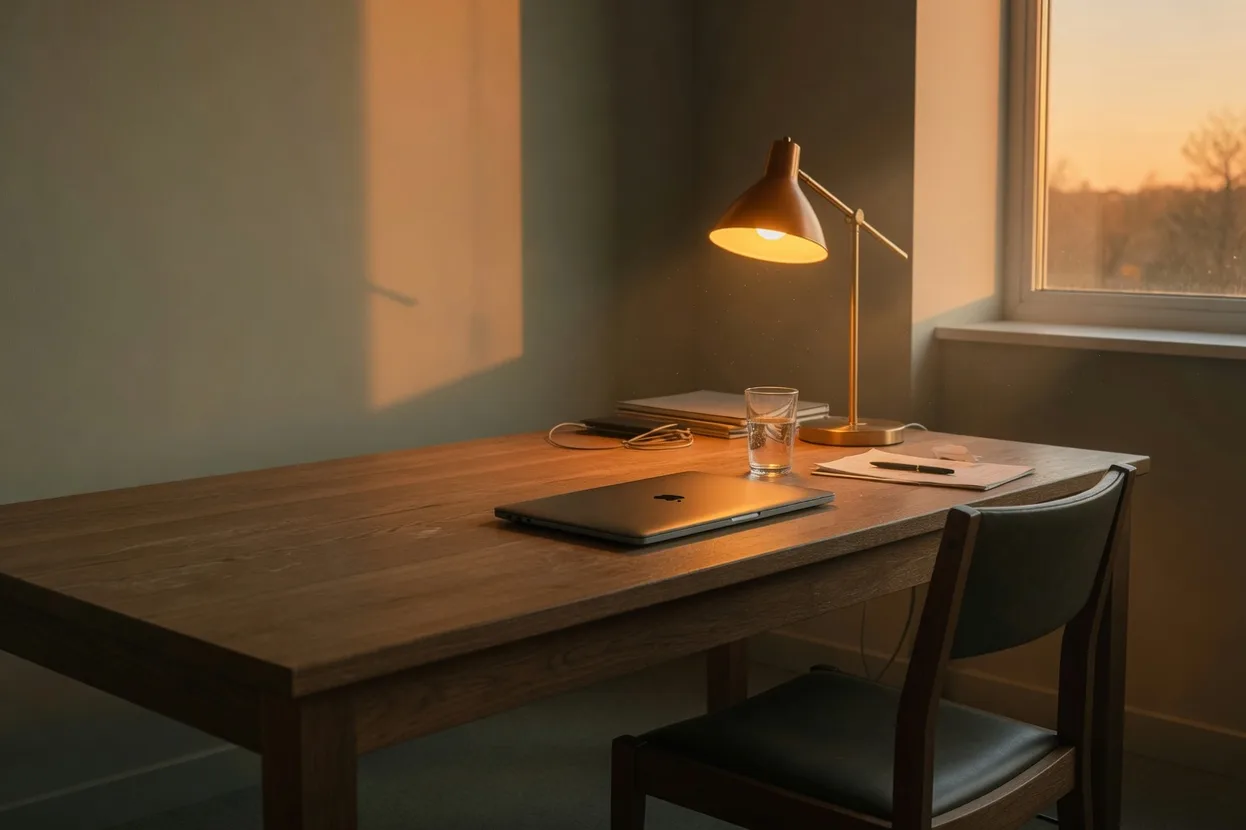
Breathwork burnout starts here with a lamp still on over an empty desk. The laptop is shut. The chair sits a hand's width back, as if someone stood up and forgot to return. The glass of water is untouched, a ring on the wood. The work has stopped. The system has not. If you know that room, this is not a motivation problem. Your nervous system is the switch that will not click back.
The calendar of that recovery lives in the burnout recovery timeline. This piece is the why, not the weeks. Not an exercise list. One chain: overload, HPA axis, cortisol rhythm, vagal tone, heart rate variability, recovery window.
What breathwork burnout does in the nervous system
Breathwork in burnout is the way slow, deliberate breathing shifts the HPA axis, the cortisol rhythm and vagal tone, read out as heart rate variability.
- HPA axis
- The HPA axis is the chain of hypothalamus, pituitary and adrenal glands that sets the cortisol rhythm. After long overload that chain stays on more easily, even when the task is already done.
You know the feeling. The task is finished. The inbox is closed. A hum stays in your chest, as if a deadline is still standing in the room. That hum is not a character flaw. It is a chain that learned letting go was unsafe.
People ask whether breathing is serious enough. Serious enough to turn the lamp off, yes. Not serious enough to replace a diagnosis. If you already see a doctor, psychologist or occupational physician, keep that care. Breathwork explains why the body stays on after the work stops. It is not a reason to delay the appointment.
If low mood does not lift, sleep fails for weeks, or thoughts of stopping appear, get professional help. I am not parking that in a footnote. It belongs in the chain. A nervous system that is stuck deserves more than a tidy sentence.
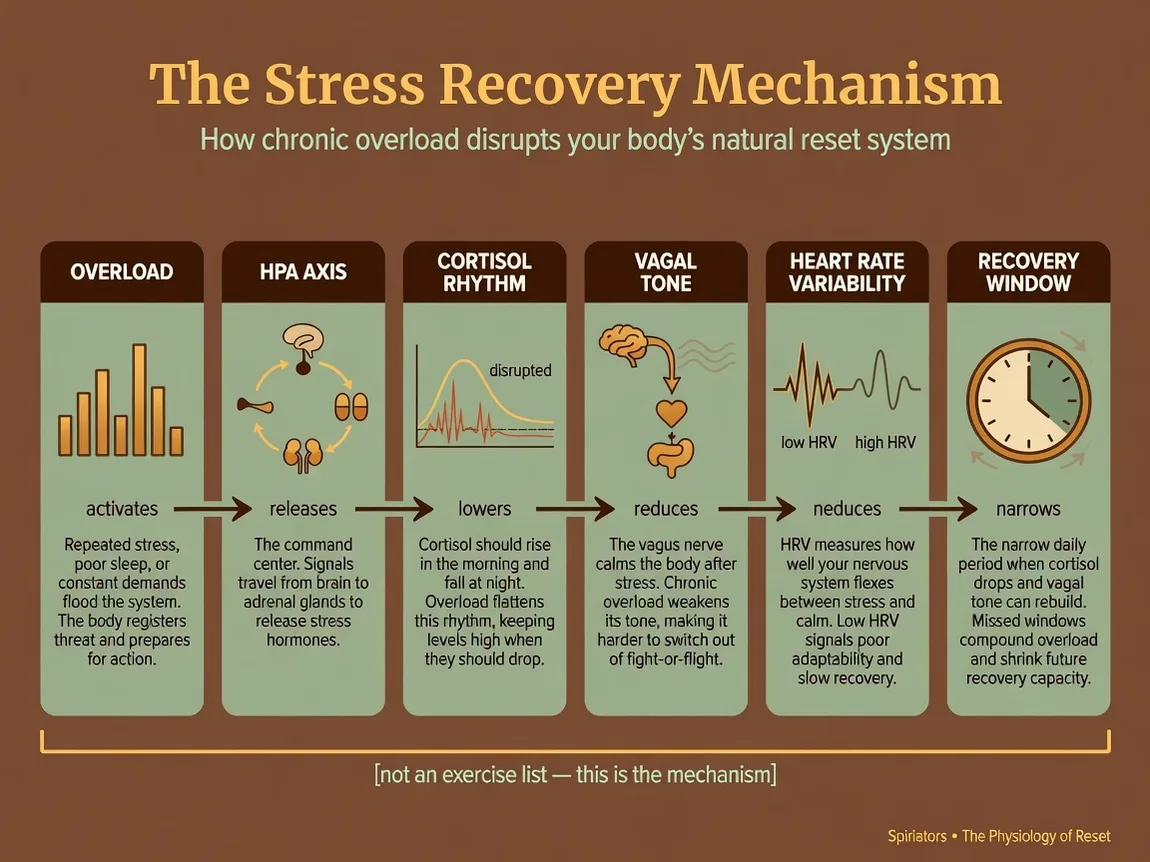
Why the lamp stays on after the work stops
Picture an office after closing time. The desk lamp has no opinion about your week. It burns because nobody pressed the switch. Overload works the same way. For months, hurry was the safe setting. Your body learned: peak is normal. Rest is the odd moment.
Cortisol is not the enemy here. It is a rhythm. A morning peak belongs, so you get up. The question is whether that peak still falls when the task is done. Under long pressure the chain from hypothalamus to pituitary to adrenal gland stays easier to leave on. You feel it as a head that will not empty, a jaw that locks, a breath stuck high in the chest.
I do not mean this only as an image. People describe it plainly. They sit on the sofa and their heart behaves as if another presentation is coming. The presentation already happened. The rhythm missed the note.
Slow breathing gives the vagus nerve a tempo that makes the brake felt again. The HPA axis does not have to switch off at once. The cortisol response peak can fall. Heart rate variability can rise. That is a mechanism. Not a promise that burnout ends in one session.
Not everyone feels warmth, tears, or a sigh that drops the whole day. Some people feel only a slightly longer exhale, or nothing special at all. That counts. Other people's vivid stories are not a promise for your body.
The chain, from overload to the recovery window
Read this as an order, not a list to tick off. Skip one link and the rest becomes a slogan.
| Link | What the body does | What breath touches here |
|---|---|---|
| Overload | Hurry becomes the default. Rest feels like falling behind. | Nothing magical. Only the signal that the task is over. |
| HPA axis | Hypothalamus, pituitary and adrenal gland keep the alarm line open. | A slower rhythm can blunt the peak. |
| Cortisol rhythm | The morning peak no longer falls when work stops. | Breath does not cure the rhythm. It gives the peak a chance to drop. |
| Vagal tone | The brake of the nervous system has gone thin. | A slow exhale makes that brake audible again. |
| Heart rate variability | The time between beats gets stiff and flat. | A smoother pattern is a readout, not a medal. |
| Recovery window | A short moment when the system dares to dim. | The window is small. Repetition widens it. One trick does not. |
Heart rate variability is the changing time between heartbeats, a readout of how smoothly the nervous system shifts back, not a score to win.
- Heart rate variability
- Heart rate variability is the changing time between heartbeats. Higher variability points to a nervous system that shifts back faster. It is a readout, not a score to win.
A watch may join in. It may not become the story. I have sat with people who celebrated a higher number and still checked mail before breakfast. The number was real. The life was not back yet.
Pro-tip: If you want to hear the rhythm without reading a protocol, set the free breathing timer to a slow exhale and let the lamp in the room be the only thing still on.
What the studies show, and where they stop
In a simulated office, after a short stress hit, young students recovered their autonomic rhythm faster when they breathed in resonance with a light cue. Research in Scientific Reports shows that this breathing sped recovery after acute stress. Eighty people, average age 23. Healthy. No clinical burnout. A visual pacemaker in the mix. That does not prove the same breath puts someone with months of collapse back on their feet. It does show that an office body, just after a peak, dims faster when the breath gets a steady tempo.
A meta-analysis of remote biofeedback, eighteen studies and more than thirteen hundred people, found a medium effect on depressive symptoms and on heart rate variability. That same analysis found no significant effect on stress. The stress result sat near p = 0.15, across eight studies. Do not say breath significantly lowers stress on the back of this review. It was biofeedback with a screen, not breathwork alone. Heterogeneity was high. What you may keep: higher variability and slightly lighter low mood can move together, while the stress score stays put.
Among healthcare workers under job strain, training around heart rate variability and breath rhythm went with less felt tension, anxiety and low mood, and with higher variability. The stronger signals sat where breath or attention was in the intervention. A review in Frontiers describes that pattern across twelve studies. Narrative, small groups, partly not randomised, little follow-up. Provisional. Not proof that biofeedback cures burnout. A hint that people in a heavy job can feel the brake again when the breath joins in.
Then the study I most want told straight. Women with high stress and depressive symptoms spent three weeks, fifteen minutes a day, on either an intense method or slow breathing plus a warm shower. Both groups fell by about the same amount: depression near a quarter, anxiety near 27 percent, felt stress near 20 percent, and cortisol reactivity dropped with them. The study shows the quiet breath with a shower matched the intense arm. No burnout diagnosis. Women only. Pandemic months. Both arms had a shower. The control is the relevant signal here, not the cold. Slow breathing can soften the peak. It does not prove a branded method is required, and it does not prove you are recovered after 21 days.
Why a higher number is not the finish
A watch that jumps from 28 to 41 feels like good news. Sometimes it is. The brake is joining in. Your heart dares to vary instead of ticking like a metronome.
Recovery is still not a figure. It sits in sleep that returns, in a boundary you keep when the boss sends one more question, in a workload that does not sneak back through the phone on the counter. The meta-analysis above is honest about that: variability and low mood can move, stress does not always follow.
So if you measure tonight and the number disappoints, you have not failed. You have a readout. Tomorrow it can differ without your life suddenly fitting. And if the number looks pretty while you are still awake at three, trust the waking. The body lies less often than a graph.
Where this piece stops, and the protocol begins
The phase protocol lives in the piece on breathwork in burnout across three phases. Dose belongs there. The why belongs here. An exercise list would empty that other piece and blur the search.
If you want the order in time, start at the timeline. If you want to feel rather than read, use the timer or book a session. If you want yoga as a bodily companion, look at yoga for burnout. That is another door. Not this chain.
The method itself sits on the breathwork guide. If doing it alone does not land, breathwork coaching is where someone sits with you while the lamp is still on. A session is sixty minutes and costs €60. You book it through contact. No vague intro call as the only way out. One hour, with a price.
Pro-tip: Read the chain out loud once, from overload to the recovery window. If cortisol stays cast as an enemy, start again. The rhythm may fall. It does not have to be defeated.
Key takeaways
- Breathwork in burnout touches a chain, not a menu of exercises: overload, HPA axis, cortisol rhythm, vagal tone, heart rate variability, recovery window.
- The lamp left on is the picture. Work stops before the nervous system does.
- Studies show pieces of the brake, with gaps. Students after acute stress are not people in long collapse. Biofeedback is not breath alone. A higher number is not recovery.
- Care from a doctor or psychologist stays in place. Breath is explanation and addition, not a substitute.
- The phase protocol and the calendar live in the sister pieces. This text stops at the why.
- Want to hear the rhythm: the timer. Want company: sixty minutes, €60, through contact.
If this lands, you do not have to redesign the whole week tonight. One slow exhale beside that burning lamp is already a switch. The rest can stay small until your body dares it.
With compassion, Johannes and Luna, on behalf of Spiriators