Sometimes your body knows before your mind does that tension has been hanging around for too long. Not as a story you need to tell, but as a gentle, involuntary movement that simply shows up. TRE, short for Tension and Trauma Releasing Exercises, is a method built around exactly that moment: simple exercises that can invite a natural tremor. Whether that tremor really “releases stored stress” remains a theory, and we set it honestly alongside the evidence that exists. In this article you’ll learn what TRE exercises are, where they come from, what the research supports so far, and how TRE relates to breathwork and yin, without any promise that something in you needs fixing.
The origins of TRE with David Berceli
TRE was developed by David Berceli, a trauma intervention educator with a PhD in social work from Arizona State University. While working in conflict areas such as Lebanon and Sudan, he noticed something: children often shook spontaneously during or after acute stress, while adults usually held the same response back. He began to wonder whether the shaking was not a sign of weakness but an innate way for the body to let tension settle. Drawing on those observations and on somatic traditions, he formalized a series of exercises in the early 2000s, designed to let the tremor arise in a controlled way without the need for extreme stress.
The method consists of a short sequence of movements that mildly tire the leg and hip muscles. You then lie down and let the tremor, if it comes, run its course. Nothing needs to be forced and nothing needs to be remembered. TRE is not psychotherapy and doesn’t ask you to tell your story. According to the method, it is meant as a body-based form of self-regulation. Berceli developed the exercises after years of watching people in extreme circumstances suppress their natural response. He wanted to make that response accessible, even without a crisis coming first.
So the origin lies in observation and method development, not in a controlled study that proves the mechanism. That’s worth keeping in mind whenever you read what TRE promises and what it can actually show.
Pro-tip: Before you try anything new, take a moment to ground yourself. Sit or lie down, feel the floor supporting you, and take a few breaths without any goal. That gives your system a starting point from which curiosity can feel safer.
How it is meant to work: theory and what the research says
According to the method, the tremor is a neurogenic tremor: an involuntary movement that originates in the central nervous system and is meant to help discharge built-up tension. Berceli observed it in children and in animals after stressful events. The theory is that humans have often learned to suppress this response, which may allow tension to linger in the body for longer. The exercises aim to make that natural response accessible again.
The evidence is still limited and preliminary. In a small randomized controlled trial with 28 people with multiple sclerosis (eight weeks; PubMed 40064004), the control group received usual care only. Fatigue, the self-reported primary outcome, did not differ between the groups in the unadjusted analysis; after adjusting for differences between the groups, it did. Self-reported spasticity and pain decreased over the study period. The authors write that further research is needed. An earlier small pilot with nine people with MS found improvements in self-reported symptoms and sleep, but it had no control group. A 2024 study protocol is examining TRE as an add-on for adolescents with emotional difficulties; no results are available yet. Critical sources such as Science-Based Medicine point out that the central claim, that tremors release stored trauma, still lacks solid biological and clinical evidence. For more background on the origins, see Wikipedia and, from the method’s own perspective, TRE Guide.
In short, the method has a clear theory, and in small studies of people with MS, participants reported improvements. It is not yet a demonstrated mechanism that proves stored stress is released in the general population. More and larger studies are needed. Among the sources reviewed for this article, there is no large, independently replicated study that separates the effect of the tremor from other factors such as rest, breathing or attention.
That doesn’t mean TRE can’t be valuable for you. It does mean staying honest about what we know and what we don’t. Theory and experience can sit side by side, as long as we keep naming the limits.
Pro-tip: Always read a claim together with its limitations. If a study is small or relies mostly on self-report, let that shape what you expect from it. Curiosity and caution can go hand in hand.
TRE exercises in a session and how to prepare safely
A TRE session usually begins with a short series of simple movements that gently activate and tire the leg and hip muscles. You then lie on your back, often with your knees bent and your feet on the floor, and allow the tremor if it arises. It may start softly in the legs and sometimes spread further through the body. You stay in charge: you decide how long it lasts and how intense it gets.
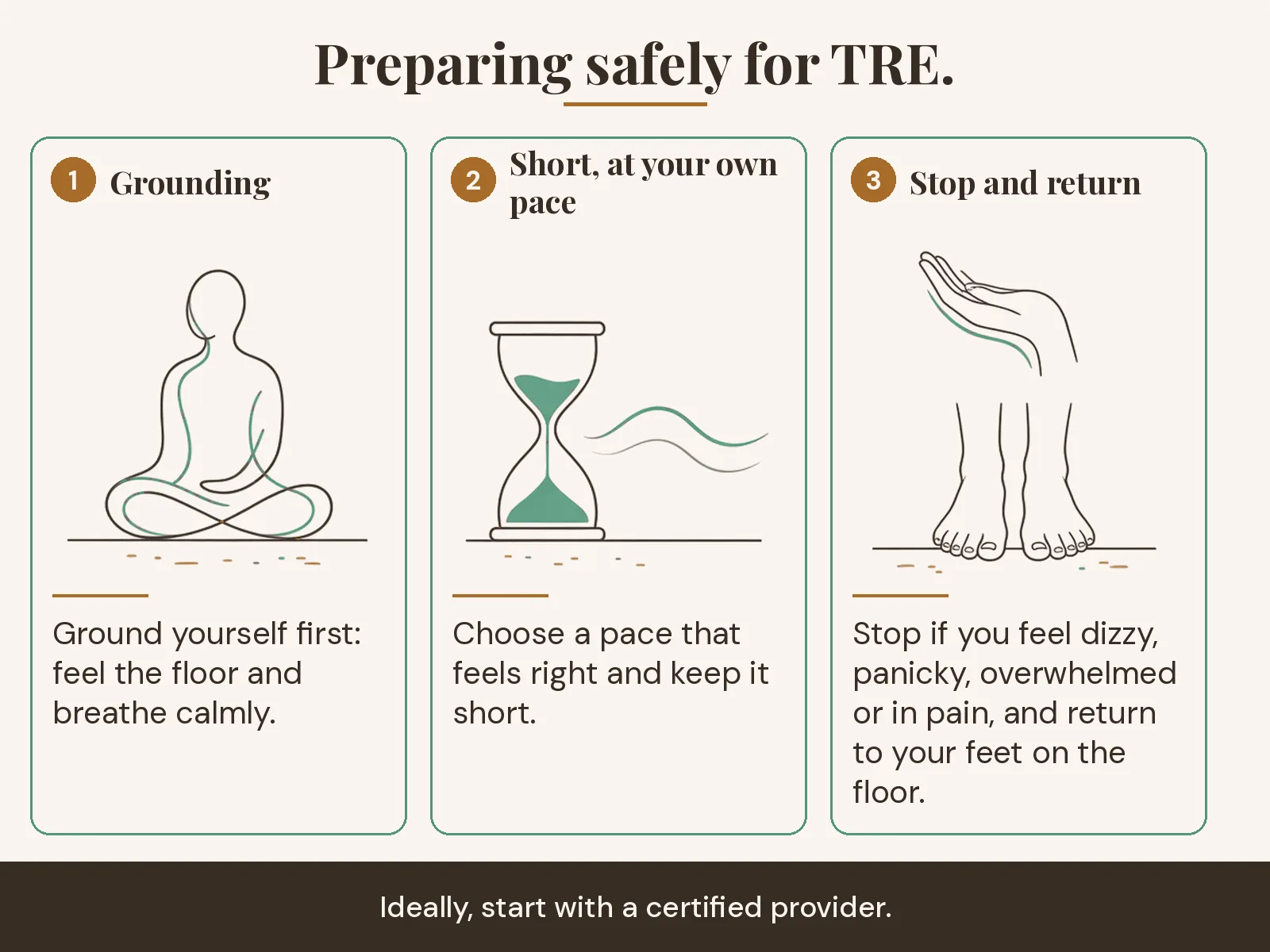
Here we stick to what a session generally involves and how to prepare safely. For your first few sessions, it is best to learn the exercises themselves from a certified TRE provider who can help you keep an eye on the pace. If you’d also like short daily exercises for your psoas and hips, there is our app Psoas Keep. Preparation comes down to four simple steps:
- Ground yourself first: sit or lie down, feel the floor supporting you and take a few calm breaths.
- Choose a pace that feels right for you and keep it short.
- Stop straight away if you feel dizzy, panicky, overwhelmed or in pain.
- Return to a grounding position: plant your feet firmly or bring your attention back to your breath.
You can pause at any time. Some people notice the tremor softening or stopping on its own. Others feel like moving or stretching afterward. Both are fine. What matters most is that you stay in control. Consistency is not the same as intensity.
A hypothetical example: someone is unsure whether TRE is right for her, because she knows old tension can sometimes surface strongly. Rather than trying it alone at home, she first books an introduction with a certified provider and agrees in advance on her stop signal, such as planting her feet and opening her eyes.
Pro-tip: Agree on your stop signal before you start, for example feet flat on the floor and eyes open. Keep it short and stop earlier than you think you need to; you can always continue another time.
Who should take extra care and seek guidance
TRE can bring up strong physical and emotional reactions. That’s why caution makes sense if you have a history of trauma, live with mental health conditions such as PTSD, dissociation or psychosis, are pregnant, have epilepsy, have heart, circulation, neurological, muscle or joint problems, or have had a recent injury or surgery. In any of these cases, talk to a doctor or healthcare provider before you begin.
The recommended route is to learn TRE with a certified TRE provider. They can help you watch the pace, ground yourself and stop when needed. Pushing the intensity is not the point. If at any moment you feel overwhelmed, dizzy, panicky or in pain, stop. You can always return to a safe, grounding position.
In a crisis or emergency in the Netherlands, help is available via 113.nl and 112; elsewhere, contact your local emergency services. This article is not a substitute for professional care.
Pro-tip: If you’re unsure whether TRE suits you, you can book an introduction first or simply start with breathwork or yin. You don’t need to force anything to stay curious.
How TRE relates to breathwork, yin and the psoas
TRE doesn’t compete with breathwork or yin yoga. It can complement them: breathwork and yin work with breath, stillness and posture, while TRE invites a physical tremor response. There is no proven synergy, and breathwork or yin do not “prepare” you for TRE in any scientifically demonstrated way. You can explore both with the same curiosity about what your body is already capable of.
The psoas plays a role in TRE exercises because the movements engage the hip flexors. You can read more about the psoas as the “muscle of the soul” and its link with emotions in other articles, for example on the iliopsoas, emotions and the hips and on the bridge between the psoas and the vagus nerve. For shaking after yin or breathwork, see this article, and for stress that can linger in the body, this piece.
At Spiriators we work from the frame that we are already whole: remembering, not repairing. TRE fits that frame as a way of giving the body room, without claiming that anything needs to be fixed. Breathwork and yin yoga are above all an invitation to settle through breath and rest. TRE can be another way in alongside them: more physical, more involuntary. You can explore them in turn or side by side. There is no proven order or synergy, only the chance to feel what works for you.
If you’d like to go deeper with breathwork, take a look at 1-on-1 breathwork coaching or the breathwork guide. For yin, there is online yin yoga. If you’d like to keep working with your psoas and hips, you can practice daily with our app Psoas Keep. And if you want to read more about nervous system regulation, the vagus handbook is there for you.
Pro-tip: Choose whatever feels most inviting right now. You might begin with breath or yin and see later whether TRE fits alongside them, or the other way around. The pace is yours.
If you have questions or want to explore what might suit you, you’re always welcome to get in touch for an introduction. Your body already holds a great deal of wisdom. Sometimes the invitation is simply to give it room.